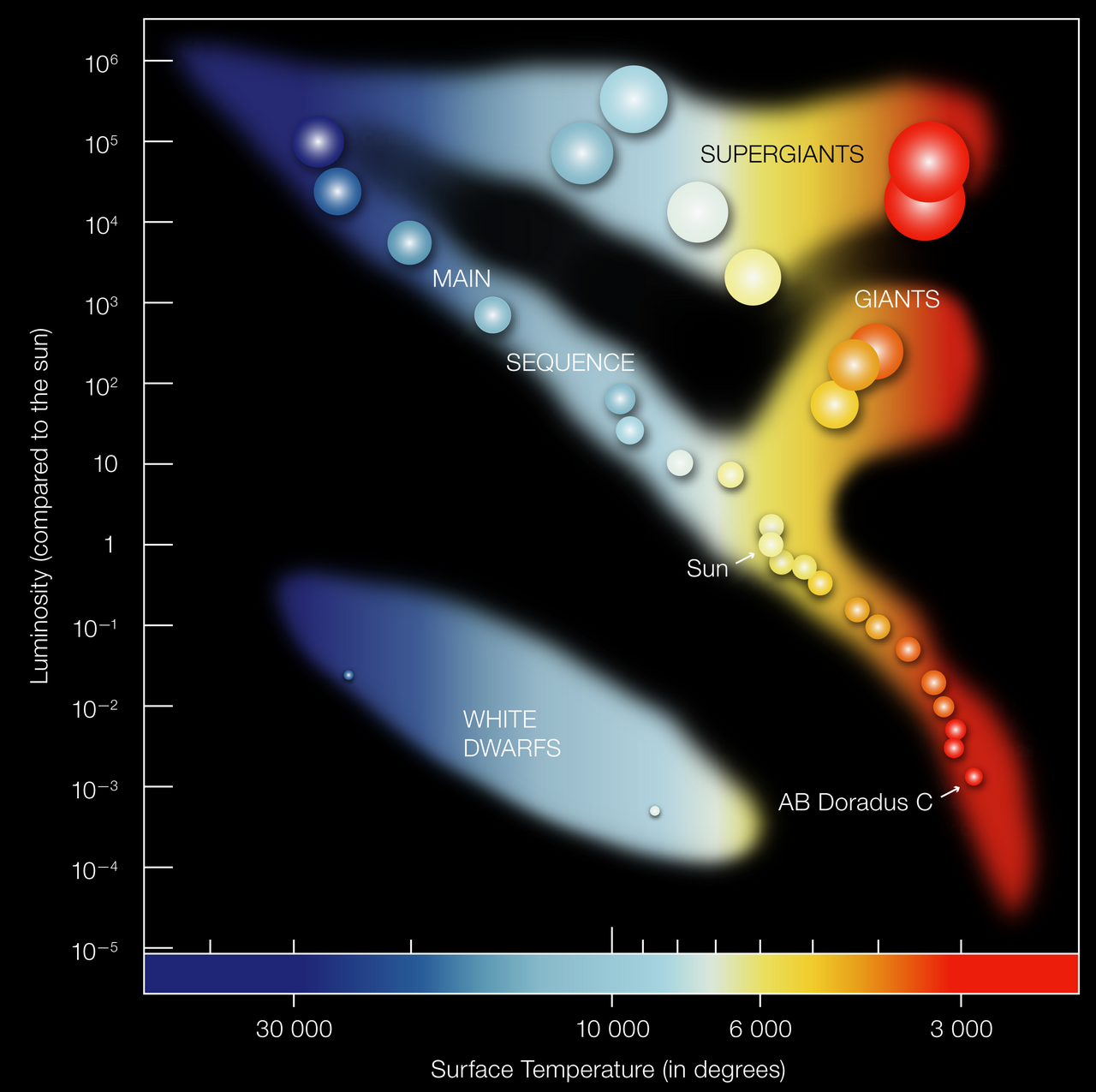
How astronomers determine the age of stars depends greatly on whether they are studying a single isolated star or a group of stars that formed together. Why are clusters easier to date? We’ll begin with the Hertzsprung-Russell (H-R) Diagram, often referred to as the “Astronomer’s Stone” because it is the principal diagram used to classify and understand the stars.
The horizontal axis lists spectral types O B A F G K M, in that order. The effective stellar temperatures decrease as one moves down the sequence: O are the hottest, blue-white stars and M are the coolest, red stars. The vertical axis measures stellar luminosities: the amounts of energy the stars produce within a given time period. The stellar luminosities increase vertically, with the least luminous at the bottom and the most luminous at the top. Yes, there is a point to all this. Please continue reading.

Along with its myriad other applications, the H-R Diagram is a particularly useful tool to help determine the ages of star clusters. We can safely assume that the stars within a clusters formed from the same nebula around the same time and so can be considered to be essentially of the same age. When the cluster first forms, every one of its constituents stars will “main sequence stars.” These are stars arranged on the H-R Diagram along a curving band extending from the upper right to the lower left. Every main sequence star generates energy in its core by fusing hydrogen into helium. As one would expect, the hottest main sequence stars are the most luminous while the coolest are the least luminous. A star’s temperature/luminosity is initially determined by its mass. The most massive are the most luminous and the least massive are the least luminous.
The H-R Diagram of a newly formed star cluster would look similar to the one below. The coolest stars are still in the T-Tauri phase, but will soon become truly active stars and will then settle onto the main sequence.

All the stars within this cluster will soon be generating energy by converting hydrogen into helium through core thermonuclear fusion reactions. However -and here’s the rub- the most massive stars exhaust their core hydrogen reserves faster than any other stars: on the order of about 10 million years. The more massive the star the shorter the duration of the hydrogen-burning phase. Once a star depletes its core hydrogen reserves, it will expand, become cooler and will eventually proceed to the helium burning stage. On the H-R Diagram, these most massive stars will move right of the main sequence, as seen below. Because of their size, they will remain highly luminous despite the decreased temperature.*

At about 100 million years after the cluster’s formation, all of the O-type stars will have gone supernova and the B-type stars will start to evolve off the main sequence as seen below. An astronomer would conclude that the cluster whose H-R Diagram is seen below is probably about 100 million years old.

And one can perhaps now see how this technique works. As time progresses more stars will evolve off the main sequence and the entire diagram can be used to estimate the cluster’s age.
Determining the age of a single star is considerably more challenging. As David Soderblom of the Space Telescope Science Institute in Baltimore once conceded, “The Sun is the only star we know the age of.” Astronomers have determined the Sun’s age of about 4.5 billion years with a remarkable degree of precision simply because we know that is the approximate age of Earth through the discovery of Hadean zircon crustal material which dates back about 4.404 billion years and is the oldest known terrestrial material.

So, while we know that our beloved Sol is approximately 4.5 billion years old, how can we possibly estimate the ages of other stars?
Astronomers can provide some workable estimates of certain stars based on observations. For instance, astronomers can identify T-Tauri stars through their light curves (how their magnitudes vary over time) as seen in the light curve of the star T Tauri, itself, the namesake of this variable star type.

Also, astronomers know that red dwarfs, the least massive and therefore longest-lived of all stars, tend to be extremely active in their youth and emit high energy ultraviolet flares. By observing such high activity in red dwarfs, astronomers can conclude that they are young (younger than 40 – 50 million years old), but cannot precisely estimate their true age.

Astronomers have a couple of promising techniques for trying to estimate the age of single stars, however
Asteroseismology:
Asteroseismology is the science of modeling the interior structure of a star through observations of oscillations within it. Through the ultra-precise photometry provided by space telescopes such as MOST (Microvariability and Oscillations in Stars), astronomers can effectively measure the speed of sound within a star. As we know here on Earth, the speed of sound varies considerably with material.** The measurement of the speed of sound within a star can yield information about the chemical composition with it: specifically about the ratio of hydrogen to helium. As we discussed earlier, all main sequence stars generate energy by converting hydrogen into helium. Measuring the amount of helium present in a ratio to that of hydrogen could tell astronomers how far along the star is in terms of its hydrogen burning phase, which would then yield an approximation of its age. The actual accuracy of this method would be difficult to determine simply because we truly only know the age of one star: the Sun.
Measuring stellar rotation:
The Nancy Grace Roman Space Teleascope, scheduled to launch at the end of this month (August 2026), will be, among other tasks, measuring the rotation rates of hundreds of thousands of stars. We presume that stellar rotation rates will decrease with time due to interactions with the stellar wind and the star’s own magnetic field: a process known as magnetic braking. This braking actually removes angular momentum, which causes a rotation rate reduction. Models suggests that after one billion years, stars of similar mass will have the same rotation rates. Therefore, if one can measure a star’s mass and rotation rate (achievable by observing periodic brightness diminishment resulting from the appearance of star spots), one can then estimate the star’s age.
While both of these techniques could help astronomers determine or at least estimate the ages of isolated stars, the process of star-cluster age determination is far more reliable and straightforward.
However, who knows what other methods might eventually be developed to enable to us to know as much about the ages of stars as we know about their masses, luminosities, life-times and chemical compositions? Before we conclude that this age determination might never be possible, we should recall Auguste Compte’s now famous1835 comment:
“On the subject of stars…While we can conceive of the possibility of determining their shapes, their sizes, and their motions, we shall never be able by any means to study their chemical composition.”
*A star’s luminosity is proportional to the square of its radius and to the fourth power of its temperature.
**For instance, the speed of sound in air (sea level atmospheric pressure; 20 degrees) is 1015 ft/sec; the speed of sound in aluminum is 21,058 ft/sec/


Leave a Reply