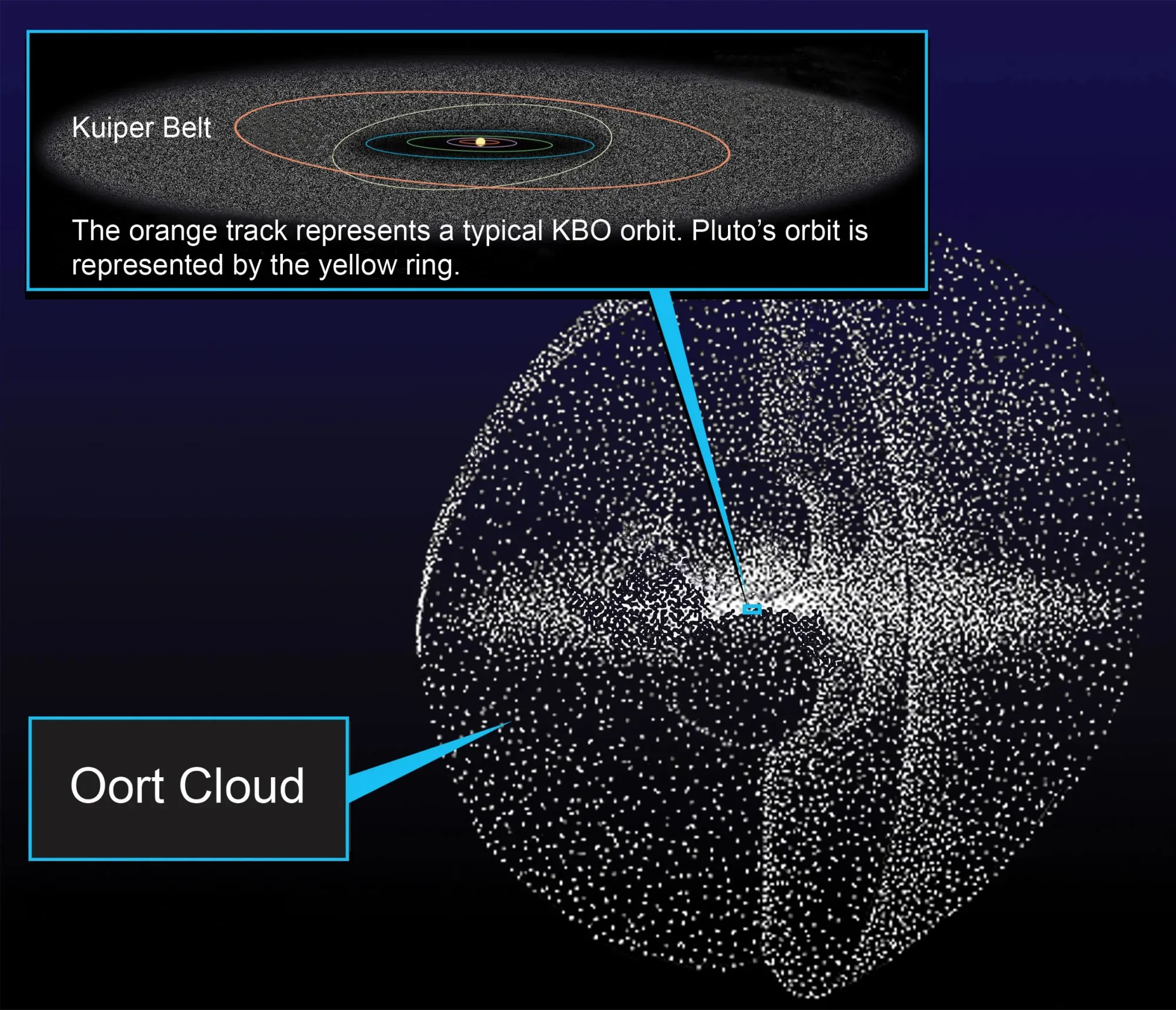

Let me begin with some background. Located within the constellation Serpens, Gliese 710 is a K-type main sequence star that is 59.5% as massive, but only about 20% as large (in terms of volume) as the Sun. Although its current distance is estimated to be 62 light years, Gliese 710 is moving toward the solar system and is expected to pass “close” to the Sun in approximately 1.29 million years. So what will happen when Gliese 71 passes through the Oort Cloud?
In 2010, Dr Vadim Bobylev of the Pulkovo Astronomical Observatory in St Petersburg, authored a study which predicted that Gliese 710 had an 86% chance of infiltrating the outer solar system, the Oort Cloud, within the next 1.5 million years.
In 2016, Filip Berski and Piotr A. Dybczyński published the paper “Gliese 710 will pass the Sun even closer,” in volume 595 of Astronomy and Astrophysics. Based on GAIA data, which was not available to Bobylev, Berski and Dybczyński predicted that Gliese 710 will attain a minimum distance of 13,365 AU from the Sun in 1.35 million years.
In May 2026, a research team led by Eloi Fernandez-Puig published the study Stellar encounters in the solar neighbourhood and the special case of GJ~710 which indicates that Gliese 710 will come extremely close to the Sun: 0.0621 parsecs (0.2024 light years; 12,800 AU) in approximately 1.3 million years.
This close approach, which, on a tangential note, will make Gliese 710 almost as bright in our sky as Jupiter at maximum brightness, should have a profound effect on the outer solar system, and ultimately, the inner solar system as it will deeply infiltrate the Oort Cloud.
Although the Oort Cloud dimensions are somewhat uncertain, estimates place the outer most shell around 100,000 – 200,000 AU from the Sun. Consequently, if the astronomers’ predictions are corect, Gliese 710 will pass well inside the Oort Cloud as it attains its minimum heliocentric distance in about 1.3 million years.

As for the consequences of this passage, we can be quite certain that thousands upon thousands of comets will be directed toward the inner solar system. The actual population of these comets cannot be precisely determined principally because of the uncertainty of the relative particle densities within the Oort Cloud “shells.”
I cite a study which predicts that the perturbing influence of Gliese 710 on the Oort Cloud could direct 2.4 million comets along Earth’s orbit. However, one should not expect to see battalions of comets swooping inexorably upon Earth in a fierce torrent. The time period for the arrival of these comets is on the order of 2 million years: perhaps one Earth-orbit crosser every year. I should point out that this is only one study, one that actually predates the latest research and so is based on different presumptions about Gliese 710’s minimum distance.
A precise answer to your question is not possible due to uncertainties in some of the variables. We know that if Gliese 710 does reach such a close distance, a myriad of Oort Cloud objects will be dislodged and likely infiltrate the inner solar system. We can, however, be quite certain that the effects on the planets, including Neptune and Pluto, will likely be negligible.
[AU = Astronomical Unit, equal to Earth’s mean distance from the Sun, or 9.296 x 10^7 miles, or 1.496 x 10^8 kilometers.
Parsec = 3.26 light years]



Leave a Reply