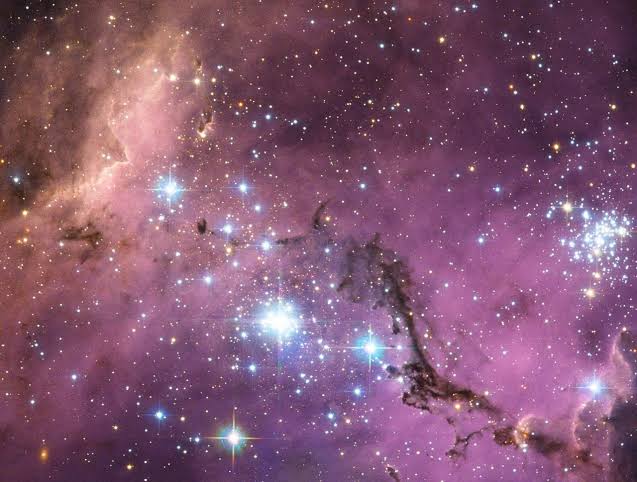

An astronomical research group led by University of Durham (UK) astrophysicist Anna McLeod recently published a paper detailing their discovery of an 12,000 AU long accretion disk surrounding HH 1177, a fifteen-solar mass star within the Large Magellanic Cloud (LMC) the most massive of the Milky Way’s satellite galaxies. Entitled “A probable Keplerian disk feeding an optically revealed massive young star,” this paper is the first to reveal the presence of an extragalactic accretion disk.
First, this finding confirms what astronomers had already expected: that such planetary formation disks were not unique to the Milky Way Galaxy.
Secondly, the disk is forming within a “low-metal” region such as the LMC. (Astronomers refer to any element heavier than helium as a ‘metal.’) Consequently, the low metal content results in higher stellar and gas temperatures. As McLeod told Astronomy magazine, “Usually, these types of stars [when in the Milky Way] are deeply embedded in their natal material, hidden from sight.” Astronomers will be able to study this forming star and disk within the visible region of the spectrum.
Thirdly, astronomers can now examine the star formation process outside the Milky Way to determine if the different environment has an affect on it. HH 1177 was found with the Atacama Large Millimeter/Submillimeter Array (ALMA) in Chile. Now, it is hoped that the team will be able to study the disk with the James Webb Space Telescope so as to examine the region within the infrared area as well.

In a press release in reference to this finding, Dr. McLeod wrote, “Being able to study how stars form at such incredible distances and in a different galaxy is very exciting.”




Leave a Reply