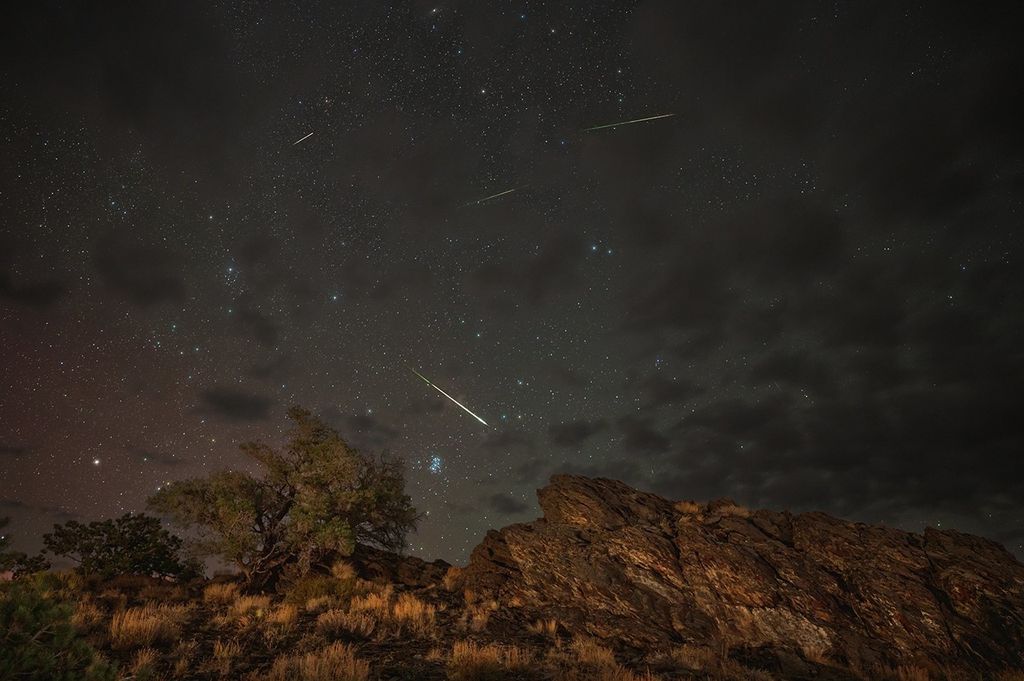

NASA/Preston Dyches
Peak date: August 13, 2026
Shower date range: July 17 – August 29
Call it “Concierge Astronomy”: the type of astronomy that only the most indulgent concierge could have arranged for your entertainment and edification. A delightful partial solar eclipse during the day (on August 12th) and a dazzling spectacle of brilliant meteors at night (both the 12th and 13th). Now, if there were any such thing as “Concierge Meteorology,” we could guarantee that you’d witness both of these existence-enhancing celestial events. Alas, the atmosphere will forever remain beyond our control.
Sometime around July 17th our lightning-quick orbiting Earth slipped silently into the outer bounds of a vast meteoroid field cast off by Comet 109P/Swift-Tuttle, a “Halley-type comet” that sweeps around the Sun along a 133-year orbit. (Comet Swift-Tuttle last reached perihelion–its closest point to the Sun–on December 12, 1992, and will next pass close to the Sun again on July 12, 2126.) During its myriad visits through the inner solar system, this jagged, fissure-ridden “dirty snowball” has left multiple trails of dust particles in its wake. The extent of this field is such that Earth will not leave it behind until August 29th. Each night some of these cometary particles will infiltrate the atmosphere at indecent speeds approaching 58.8 km/sec (131,000 miles per hour or thereabouts.) The resultant excitation of the atmospheric atoms within the vicinity of each descending meteoroid will produce a rapid spasm of light we see as a meteor.
(A quick note about three terms that are often used interchangeably:
METEOROIDS: particles cast off by comets, and sometimes by asteroids, that are loiter in maddening abundance within the inner solar system.
METEORS: the light produced when meteoroids descend through the atmosphere.
METEORITES: remains of meteoroids which survive the descent and are then found on Earth’s surface.)
We are now about to pass through the densest region within this meteoroid swath and so we will experience a peak, which, this year, occurs on August 13th. One can therefore expect to see beautiful showers of Perseid meteors on the nights of the 12th and 13th. During the other nights within the range (July 17 – August 29) the Perseids will not be as active and will often be indistinguishable from sporadics (one can see about 4 – 7 sporadic meteors an hour on any given night).
During the peak night, we can expect to see perhaps dozens or even scores of meteors an hour, provided that we start looking late in the evening, the time when the radiant–the point from which the meteors appear to originate–rises. This radiant is located within the constellation Perseus, hence the name Perseids.
The Zenithal Hourly Rate (ZHR) of the Perseids is about 100. Consider this number to be a Platonic Ideal value: the number of meteors that a seasoned observer would see if he/she were in a completely dark, crystal clear, moonless sky in the part of the world where the radiant would pass along the zenith. (Along 58 degrees North: close to the Hyperborean realms within Canada, Russia, Scandinavia, Scotland, etc.) Those of us less geographically blessed, in lower areas tinctured by urban light glow, can perhaps expect 35-50 meteors per hour.
All the same, as the subject line subtly suggests, this week will be a perfect time to see the Perseids because the moon, which will be providing the eclipse entertainment during the day, will be utterly and delightfully absent from the night sky on both the 12th and the 13th. On the 12th, it will be new and on the 13th, it will be an atomically thin crescent that will vanish into the evening twilight. Meteor showers are best seen when the moon is off stage. This year, we will see the Perseids without any lunar light interference at all.
Q/A
What is the absolute best time to watch for Perseid meteors? It’s best to watch after midnight, the time when your part of the planet will be turning into the meteor stream. Watching in the early evening will likely prove disappointing because the radiant will still be below the horizon.
Does the Perseid Meteor Shower happen around this time every year?Yes! Although the actual peak date might vary slightly from year to year, one can expect to see the Perseids in mid-August each year.
Do I need eye protection? Not in the least. All you need is a clear sky, which, alas, I cannot guarantee.
Um, has anybody ever been killed by a meteorite? There are no confirmed cases of anyone having been killed by a meteorite. Only one person, Anne Hodges, is known to have been struck by a meteorite. In 1954, Ms. Hodges was asleep in her home in Oak Grove, Alabama, when a piece of a meteorite fell through her roof and struck her on the hip. She survived the incident and became an instant celebrity.
So, even if the skies are cloudy on the 12th and 13th, I could still see Perseid meteors throughout the month? Yes, you’ll be able to see Perseids throughout most of August, but the meteor appearance rate won’t be as intense later on in August as it will be on the 12th and 13th.
What is a “bolide?” A bolide is merely a larger meteoroid that literally explodes in the sky, producing a shockingly bright incandescent light for just a moment. Although bolides are far less common than what we might call “ordinary” meteors, they are far more memorable.
If you have any questions or comments, please contact Edward, “The Wandering Astronomer,” at edwardherrickgleason@gmail.com or (709) 691-2560. Also, please consult my website: WanderingAstronomer.com.


Leave a Reply