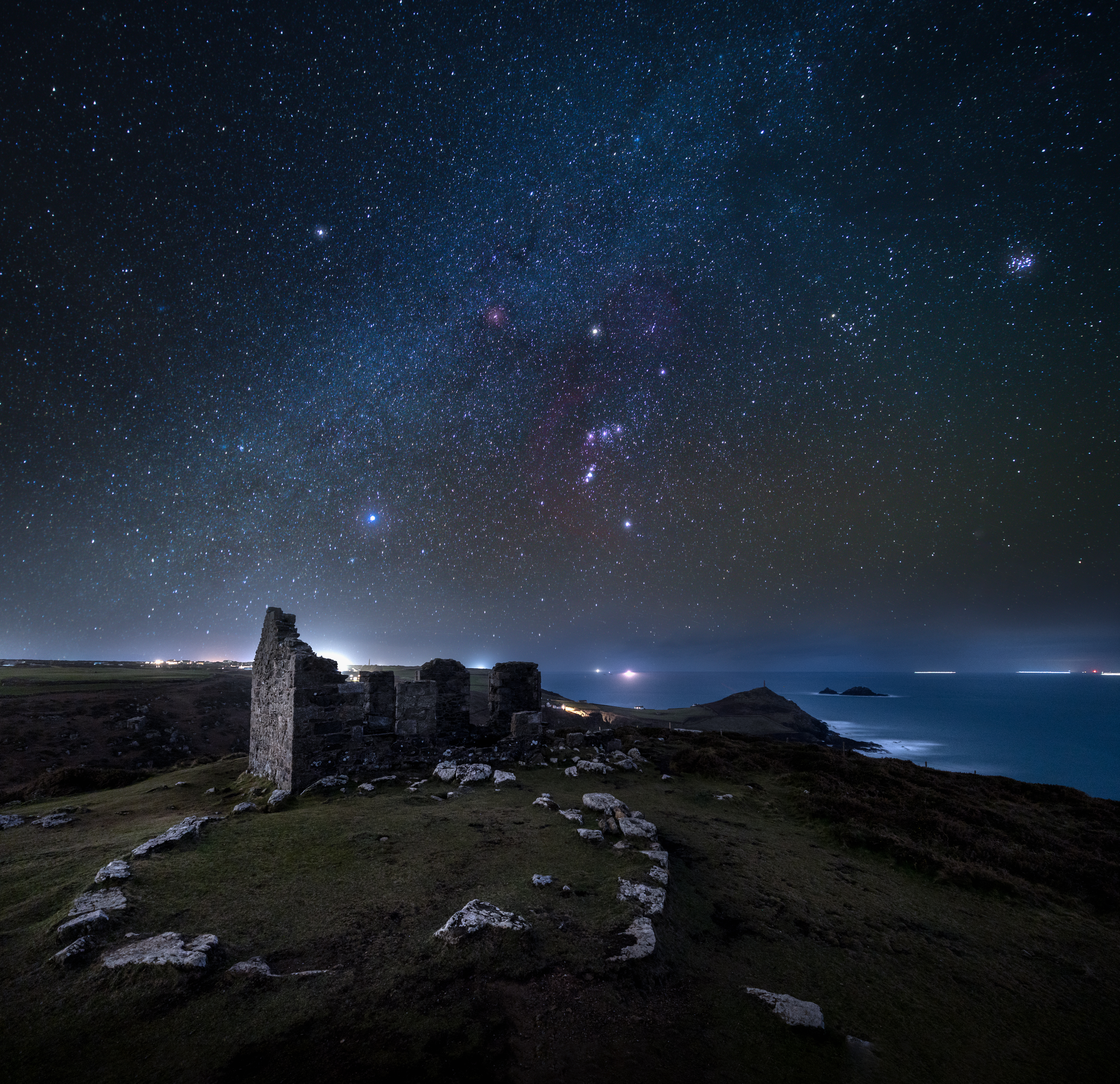
And so a new year begins. By this statement we mean, of course, that Betelgeuse has finally emerged in the pre-dawn sky following a seemingly interminable two-month hiatus within the obscuring twilight veil. One might recall that Betelgeuse vanished into the evening twilight on May 21st. Its July 21st return heralds the beginnning of another Orion Cycle.
If you had been watching the eastern pre-dawn sky this morning you might well have caught a glimpse of Orion’s eastern shoulder star for a fleeting moment before the intensifying dawn twlight absorbed it. Had you been watching the eastern pre-dawn sky yesterday, the sky would have been just slightly too bright to allow you to observe Betelgeuse. If you watch the same sky tomorrow morning, you’ll see it for a full four minutes longer than you were able to watch it today. Astronomers say that around latitude 43 degrees, Betelgeuse’s heliacal rising is July 21st: the first morning the star becomes visible. In the same vein, astronomers will say that Betelgeuse’s heliacal setting is May 21st: the last time the star remains visible before it exits stage west.
Unless you’re living north of the 82nd north parallel, where it is circumpolar and always visible, or you live south of the 82nd south parallel, where it is never visible, Betelgeuse, like the other stars, will regularly rise and set. In all the regions between 82 degrees north and 82 degrees south, Betelgeuse will not remain visible all year, but, instead, will spend some time too close to the Sun to be seen. The duration of its absence, as well as the dates of its heliacal rising and setting, varies with latitude. Because Betelgeuse is positioned about eight degrees north of the celestial equator, its helical rising date will be earlier the farther north you venture. Betelgeuse emerged a few days ago well north of us. Of course, those farther south will have to wait a bit longer before Orion’s fire opal star ascends out of the morning twilight.
We all know that stars (Polaris apart) do not remain in the same place throughout the year. They rise four minutes earlier each day as a consequence of Earth’s orbital motion around the Sun. This increase accounts for nearly half an hour a week, or two hours every month. By the end of August, Betelgeuse will be visible for nearly two and a half hours before it fades into the twilight. Six months from now, Betelgeuse will return to prominence in our winter evening sky, just as it’s done for centuries.
This is not a constant, however. At least not in the long term. The nearly 26,000-year precessional wobbling of Earth’s axis will gradually shift Betelgeuse and the other stars so that eventually they’re heliacal risings and settings dates will change. The earliest generation of Stonehenge builders would have seen Betelgeuse vanish into the evening twilight by mid-March and return by mid-May: the very time when we now bid it farewell.
However, this long-term shift accounts for only one degree every 73 years. For the rest of our lives, we can expect Betelgeuse to disappear around May 21st and return on July 21st.
So, through today’s heliacal rising of Betelgeuse we are connected, albeit remotely, to next May, a time that seems now to be decades in the future, but which will, most assuredly, arrive with startling haste. A new Orion cycle begins.
Latest Posts
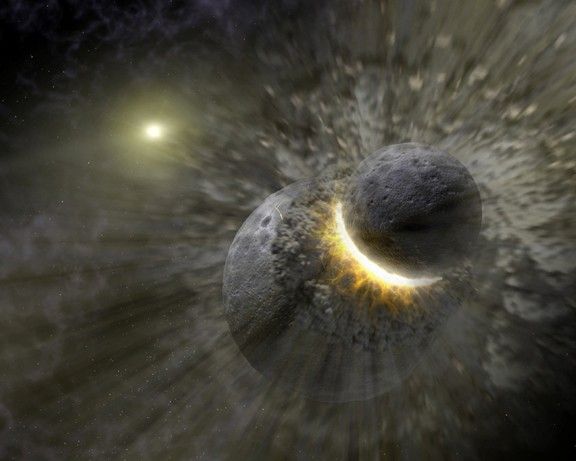
- How Did the Moon Form? The Violent Collision That Created Earth’s Moon
 How did the Moon form? Explore the violent collision that created our lunar companion, its early relationship with Earth, the origin of its phases and tides, and the Moon’s enduring place in human mythology.
 - What is the Drake Equation?
 The Drake Equation attempts to estimate how many communicative alien civilizations might exist in the Milky Way. But with most of its variables still unknown, calculating the answer involves as much educated speculation as mathematics. Here’s what the equation tells us—and what it reveals about our search for extraterrestrial life.
 - IMPORTANT CHANGE–LUNAR ECLIPSE VIEWING WILL BE AT SIGNAL HILL (UPPER PARKING LOT/VIEWING AREA), St. John’s, Newfoundland, Friday, August 28, 2026, 12-3 am. FREE!!!
 Join us at Signal Hill to view the partial lunar eclipse in St. John’s, Newfoundland, from 12–3 a.m. on August 28.
 - Mogh Ruith Virtual Planetarium Now Booking School Programs for Fall 2026
 Mogh Ruith Virtual Planetarium is now booking school programs for Fall 2026. Explore the night sky through virtual star tours or share a presentation on the Moon, the secret night sky, or night-sky mythology with your students. Also offering Earth Systems 3209 curriculum support. Each one-hour session includes a question-and-answer period and a night-sky tour, presented by Astronomy Now columnist and veteran planetarium director Edward Herrick-Gleason.
 - Did Dark Matter Kill the Dinosaurs?
 Dinosaurs exercise a strange fascination over humanity, owing, perhaps, to their disproportionate sizes, exotic structures, and temporal remoteness. Some loomed taller than buildings and extended over a hundred feet. They assumed various forms: horned, quadrapedal, duck-billed and even winged. And, the last of the dinosaurs (not counting the ones that evolved into today’s birds) trod… Read more: Did Dark Matter Kill the Dinosaurs?


Leave a Reply