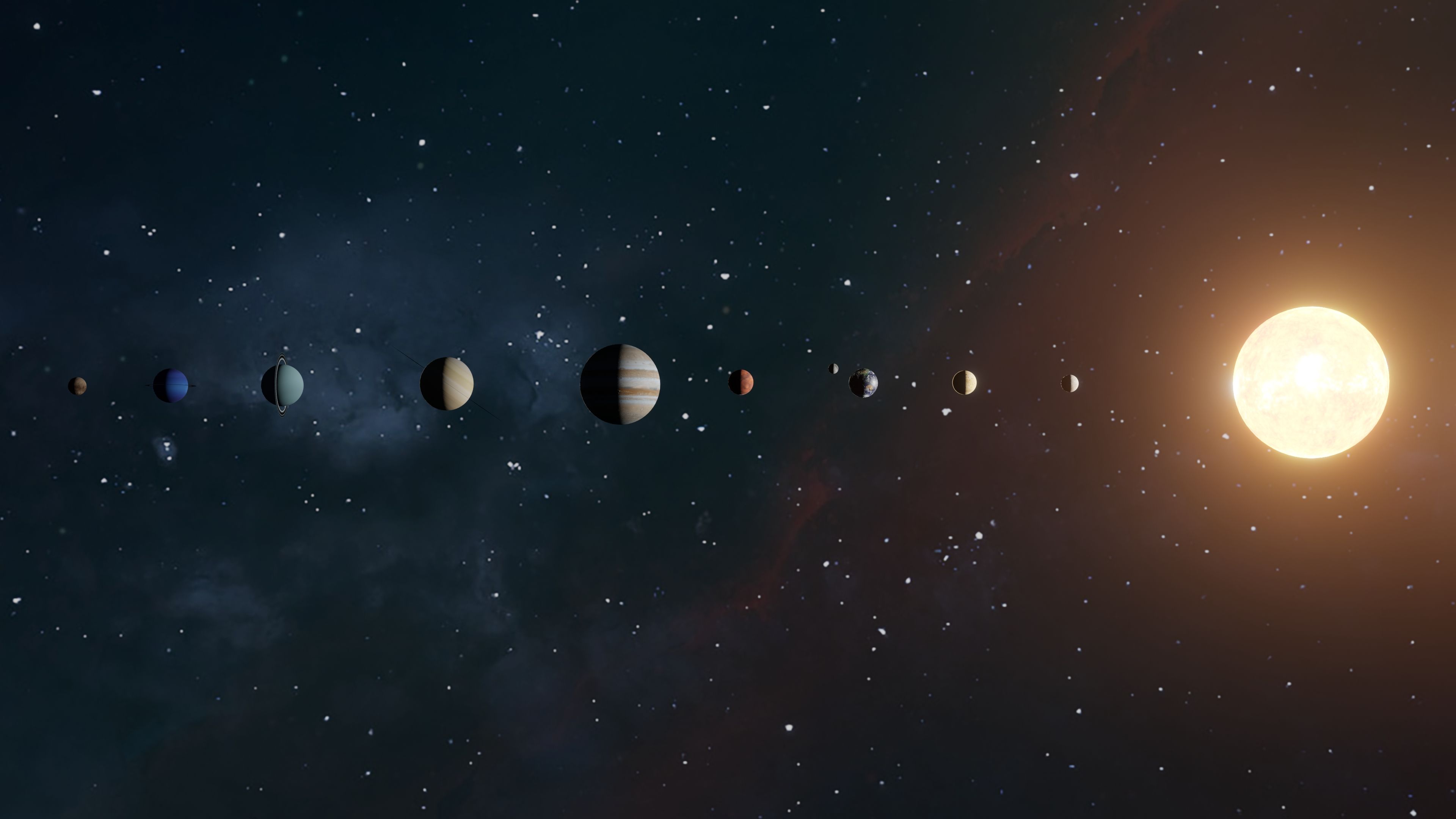
I want to offer two answers:
First, astronomers have only found one other solar system containing eight confirmed planets: Kepler-90, otherwise known as 2MASS J18574403+4918185. The name Kepler-90 derives from the now defunct Kepler mission (2009–2018) that discovered these worlds through the transit method. (This method involves observing the slight and periodic light diminishments resulting from the passage of a planet across its star.)
Located 2,790 light years away within the Draco constellation, Kepler-90 has been found to harbor eight known planets. All of these known worlds travel along orbits that are smaller than Earth’s, as we can see from the graphic below.
So far, no other star system has been found to contain this many worlds. However, one cannot be certain as to the total number of planets in orbit around Kepler-90. In fact, the working presumption is that the number of confirmed exoplanets around any star is likely not to be comprehensive. Our detection techniques might not be able to discover every exo-planet around other stars. (We’re still trying to puzzle out the entire planet census around the Sun!)
That statement leads to my second answer: There are likely millions, if not billions, of stars that contain eight planets or more. This assertion is based merely on intuition. Our previous belief, predicated largely on Kepler findings, that every star contains at least one planet is likely to be false. “Metal-rich” stars, those containing elements heavier than helium, are likely to all have planets, while “metal-poor” stars are likely to have few or none at all. (A study of the Omega Centauri globular cluster published in the Astrophysical Journal in 2018 entitled “Habitability in the Omega Centauri Cluster” showed disappointing results for exo-planet hunters despite the previous belief that such clusters could harbor a plethora of planets. Whether or not this unexpected dearth of planets is the result of metallic deficiencies or the high probability of planetary orbit disrupting encounters remains a contentious issue, however.)
However, the metal-rich stars have generally been found to possess many attendant planets. The chances of many metal-rich stars having eight or more planets is high considering that circumstellar, or protoplanetary, discs containing ample quantities of planet-forming material is quite high.




Leave a Reply