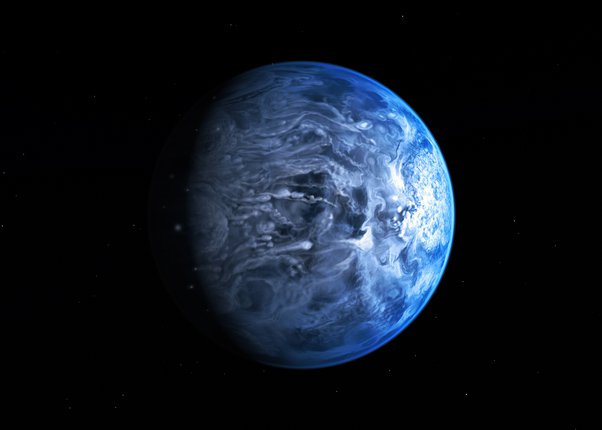
It is the ultimate of all astronomical inquiries. Out there, in that unbounded inky black infinitude, among the myriad stars, innumerable planets and veritable googleplex of unknown entities, could there lurk another Earth? A warm, verdant, cerulean blue sphere shining like a spherical lapis lazurite in the hollows of that eternal night. A special place where, like here at home, life forms have evolved to the stage at which their adrenal glands are so much larger than their pre-frontal cortices that persistent peace will remain forever elusive. HD 189733b, a blue exoplanet a mere 64.5 light years away, certainly looks like it might be such a world.

Located within the constellation Vulpecula, this azure orb appears lovely and inviting. One can almost envision the occupants of a space vessel cockpit–cast in shadowy light to extenuate the make up while simultaneously concealing the plastic surgery scars–as they stare at this world growing ever larger in their panoramic view field. Their collective despair changes to exultation as they approach their ‘new home.’
Well…
These intrepid space explorers might find Earth 2.0 to be a bit less hospitable than the original Earth they abandoned. First, HD 189733b is snuggling rather close to its parent star, an orange dwarf that is the larger of the two stars comprising the binary system named HD 189733. In fact, the planet’s average distance from this orange dwarf is 2.5 million miles. Compare this value to Mercury’s average separation distance from the Sun of 36 million miles. At this distance, the planet is tidally locked with its parent star so that one side always faces the star, while the other one is always pointed away from it. The star-facing side sizzles at 1,700 degrees F. The opposite side is only about 500 degrees cooler. With a mass 16.2% and a radius 13.8% greater than than of Jupiter, HD 189733b is truly one of the ‘Hot Jupiters,’ a place that is hardly conducive to life’s development. Moreover, those clouds pour forth molten glass that is so whipped by the planet’s 4,500 mph winds that its falls horizontally.
So, let’s review the features of Earth’s twin:
- Fiercely hot on one side; scorching hot on the other side
- molten glass rain
- ferocious supersonic winds
- crushing gravity
- probability of finding indigenous life as close to zero as possible
- probability of establishing a colony so as to continue our noble effort to expand out into and ultimately improve the galaxy: Zilch.
Alas, we encounter another example in which an image doesn’t tell the whole story. This lovely Earth-like world will not serve as a second home at all. However, we shouldn’t be discouraged by this disappointment. Our searches will eventually uncover–I resisted the temptation to write ‘unearth’–another world hospitable to life. In fact, we might discover millions of them in our galaxy alone. Until then, we can still dream.



Leave a Reply