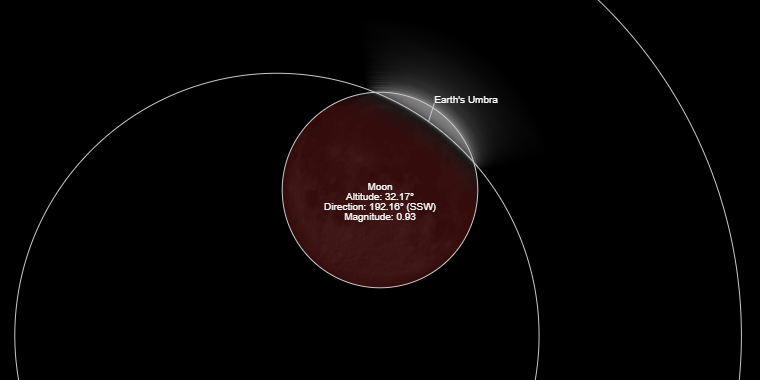

On August 12th we watched the moon glide gracefully in front of the Sun. Now, on the night of August 27–28, 2026, a partial lunar eclipse will be visible from St. John’s, Newfoundland. The August 27-28 event will be a partial lunar eclipse because part of the moon will remain outside Earth’s umbra or inner shadow. However, this celestial sight might well be worth a second glance because most of the lunar disc will be immersed in the crimson shadow. Also, we’ll have to wait almost three years before we’ll be able to see another total lunar eclipse here in St. John’s. (See Q/A below).
Although the event technically begins on the 27th, the actual partial eclipse will start just after midnight on the 28th. (Please refer to the time table below.) Not only will we be able to see a reddish “copper moon” on the 28th, but the color differential along its disc will lend it a distinctly three-dimensional appearance. It will actually resemble a sphere in space (which, of course, is what it is).
TIME TABLE
10:53 p.m. August 27th PENUMBRAL ECLIPSE BEGINS
The moon will enter Earth’s penumbra or outer shadow. No need to rush outside quite yet. Even when it is wholly immersed in the penumbra, the moon appears almost the same as it does when it is outside. Apart from a subtle darkening, there is not much to see here. In fact, many people, WA included, notice nothing at all.
12:03 a.m. August 28th PARTIAL LUNAR ECLIPSE BEGINS
Now would be a splendid time to venture outside, because at this moment Earth’s umbra, or inner shadow, will start to move across the Moon. Initially the shadow will appear as a thin black arc expanding along what–to us–is the left side of the moon.
1:42 a.m. August 28th MAXIMUM LUNAR ECLIPSE
Most of the moon will now be immersed within the umbra. The umbral magnitude–defined as the percentage of the moon’s diameter that is covered by Earth’s inner shadow at maximum eclipse–will be 0.9319 (or 93.2% of the moon’s diameter.) The obscuration, or the percentage of the moon’s area covered by the shadow, will be about 96%. All but the upper “right” limb of the moon will be steeped in umbral shadow. The upper limb, though wholly immersed in the penumbra, will appear to shine quite brightly by contrast.
3:21 a.m. August 28th PARTIAL LUNAR ECLIPSE ENDS
Essentially, at this moment the show is over. The moon will exit the umbra, and the dark shadow that had moved across and then away from the moon will vanish. Although the moon will still remain within the penumbra, as mentioned before there won’t be much to see at this point.
4:31 a.m. August 28th PENUMBRAL LUNAR ECLIPSE ENDS
We assume that by now you’ve already returned to bed, because a penumbral eclipse isn’t truly worth the sleep deprivation. At this moment the moon will move out of the penumbra. The lunar eclipse has now drawn to a close.
Lunar Eclipse Q/A:
Why does the eclipsed moon look reddish?
The “ring of fire,” here defined as the ring of sunrises and sunsets along Earth’s terminator–the boundary separating the dark and sunlit regions–directs reddish light into the shadow cone. This reddish light is reflected off the lunar surface during a lunar eclipse.
If the lunar eclipse is partial here, does that mean it is total somewhere else?
No. If a lunar eclipse is partial here, it will be partial everywhere else where the eclipse is visible. (Total solar eclipses, in contrast, are total only along a relatively narrow path (no more than about 165 miles) called the “totality path.” Observers in regions surrounding this path will see only a partial eclipse, the magnitude of which decreases with increasing distance away from the totality path.)
You told us that eventually solar eclipses will come to an end. Is that also true with lunar eclipses?
No, actually. Although the moon is moving away from Earth at the staggering speed of 3-4 cm per year, it will never be so far away as to pass beyond Earth’s 1.35 million-km-long shadow cone. Currently, the moon’s average distance from Earth equals about 384,500 km. In approximately five billion years, when the Sun expands into the red giant phase, the moon’s average distance will likely equal about 540,000 km. Although that value is a bit uncertain, it is still well within the shadow-cone distance. While solar eclipses probably end in a few hundred million years, total lunar eclipses will persist until the Sun reaches the end of its life cycle.
When will we next be able to see a total lunar eclipse in St. John’s?
We’ll have to wait until 2029 to see the next total lunar eclipse. However, that year we’ll actually be able to see two of them.
The next total lunar eclipse visible from St. John’s will occur on June 25-26, 2029.
The subsequent total lunar eclipse visible from St. John’s will occur on December 20-21, 2029.
I should point out that there will be a penumbral lunar eclipse on February 20, 2027 and another one on August 17, 2027. However, as mentioned in the timeline above, a penumbral eclipse is truly a celestial non-event. Also, there will be a partial lunar eclipse on Jan 11-12, 2028. However, the magnitude of that eclipse will be 0.066, meaning that the moon’s shadow will merely cover a small arc along the moon, an event that would captivate only the most fanatical of eclipse observers.
Wait! Wait! Why is it that St. John’s will have to wait until the early 23rd century to see a total solar eclipse, but we’ll be able to see two total lunar eclipses in 2029?!
Total lunar eclipses are seen much more often than total solar eclipses because during a lunar eclipse we’re standing on the shadow-casting body. Consequently, any observer who can see the moon in the sky during totality will be able to see the eclipse. Conversely, a total solar eclipse is only seen by those within a relatively small, narrow totality path. No totality path will cross over St. John’s before 2205.
Based on the population density of the region through which the totality path of the August 12th total solar eclipse passes, about 15.2 million people (or 0.19% of the world’s human population) will be able to observe the total solar eclipse. (This does not include the people who will be traveling from all parts of the world to watch the eclipse.) In contrast, about 1.28 billion people (15.9% of the world’s human population) will be able to see this partial lunar eclipse.
Why is it that solar eclipses and lunar eclipses generally occur in pairs?
A lunar eclipse generally follows or precedes a solar eclipse by two weeks because these eclipses can only happen when the new moon (solar eclipse) or full moon (lunar eclipse) occur at or near a node, an intersection point between Earth’s orbit and that of the moon. There are two nodes, which are separated by 180 degrees. Since the positions of the new moon and the full moon are also separated by 180 degrees, if the new moon is near one node, the full moon will tend to be near the other one.
Will I need eye protection to watch this eclipse?
Not at all. All you need is a clear sky, which, of course, is all but assured here in Newfoundland.


Leave a Reply