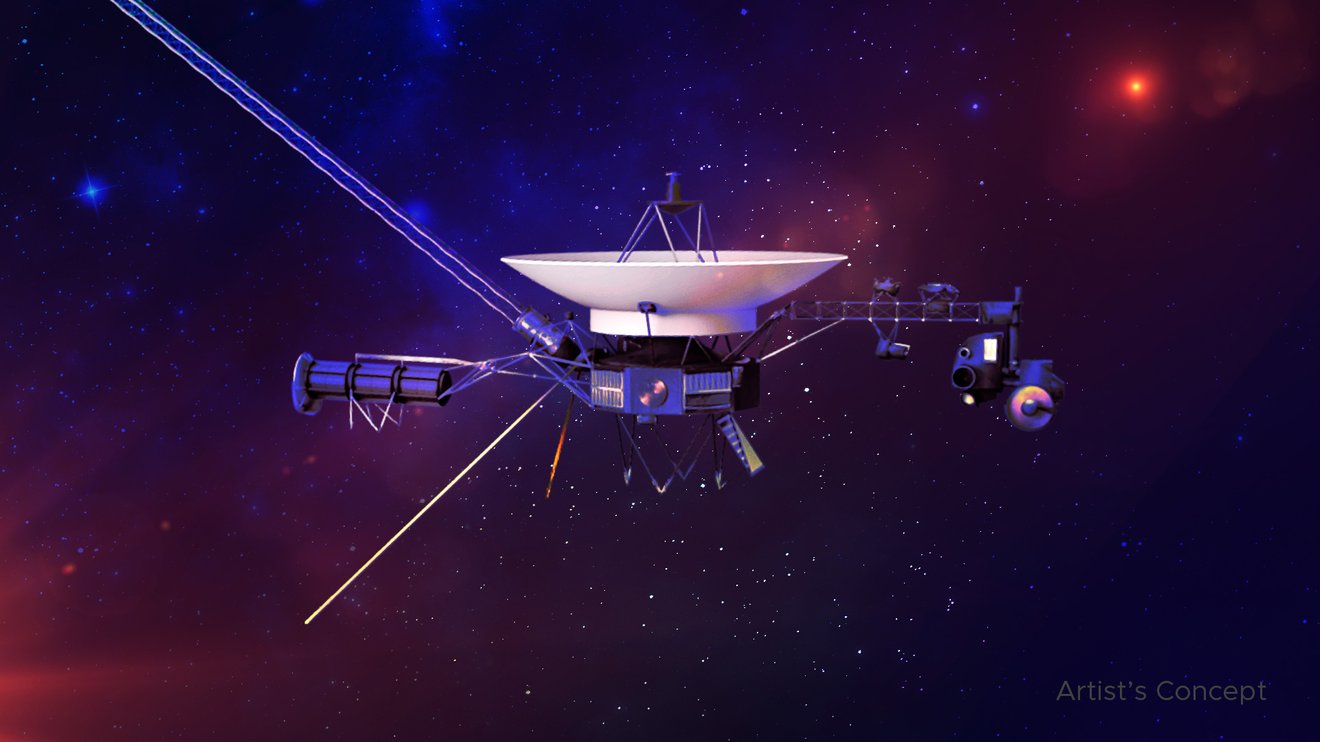

At a distance of 171.42 AU (15.94 billion miles) from the Sun, Voyager 1 is farther away from the Sun than any other spacecraft. It continues to move out of the solar system at the speed of 16.918 km/sec (37,829 mph). Voyager 1 is moving outside the heliosphere, which it crossed in 2012.
Speed is a very tricky business in outer space. On Earth, we are accustomed to measuring the speed of an object within a fixed reference frame (car on a freeway; pedestrian on pavement) or in relation to a fixed object (jet flying from New York to Paris). We can measure Voyager 1’s speed relative to the Sun (16.918 km/sec) because we can consider the Sun’s position to be fixed in reference to the spacecraft. Even though the Sun is moving through the galaxy at 143 miles per second, the Voyager 1 craft, still within the Sun’s gravitational influence, travels with it. Matters become dicey once Voyager 1 breaks the Sun’s bounds altgoether and moves unattached through the galaxy. Suddently, it is moving among the stars, albeit at a much slower speed. [To use consistent units: the Sun moves at 514,000 miles per hour through the galaxy; Voyager 1 travels at 37,829 miles per hour.] These speeds are all measured in reference to what is known as the local standard of rest.
So where has Voyager 1 gone, and what lies ahead? First, Voyager 1 has already moved through the Kuiper Belt–a circumstellar disk consisting of short period cometary nuclei–unscathed. This disk extends between 30–55 AU.* We should mention that Voyager 1 is leaving the solar system at a 35 degree angle relative to the ecliptic. The main concentration of Kuiper Belt objects (KBOs) is within 10 degrees of the ecliptic. The density diminishes considerably with increasing distance away from this disc. Consequently, it shouldn’t have passed anywhere near any KBO. However, even it had been moving through the main disk, the probability of an impact should have been very low. The sum total of KBO’s is estimated to be slightly less than two percent of Earth’s entire mass. That material is distributed over an immense area: the Kuiper Belt’s innermost circumference equals 17.5 billion miles.
Eventually, Voyager 1 will encounter the Oort Cloud region, a vast spherical region from which long period comets originate. At the moment, Voyager 1 is 171.42 AU from the Sun. It is possible that in about 28 years, Voyager 1 will reach the “Hills Cloud,” a hypothetical distrbution of cometary nuclei believed to define Oort Cloud’s innermost section. (The main Oort Cloud, itself, extends between 2,000 – 200,000 AU. (At its current speed, Voyager 1 will reach the closest part of the Oort Cloud in 58,700 years.) Even though the Hills Cloud, if it even exists, should contain five times the amount of material contained within the entire Oort Cloud system, Voyager should be able to move through it unmpeded simply because of the vast spaces separating the objects: which are scattered over hundreds of billions and even trillions of miles.

This brings us to another question: where does the solar system end? A question with various answers. One could argue that the solar system ends at the Kuiper Belt, the regions of cometary nuclei beyond Neptune’s orbit. It extends out to 55 AU. Voyager 1 passed through this belt in the 1990s.
On the other hand, the heliosphere could be said to define the solar system’s boundary, as that marks the boundary where the Sun’s magnetic influence ends. (The solar wind is “pushed back” by interstellar material.) Voyager 1 officially passed through this boundary in August 2012.
However, if one defines the solar system’s edge as the region where the most distant object held by the Sun’s gravity is located, then it extends to the outermost Oort Cloud object, which could be 200,000 AU from the Sun. Voyager 1 won’t reach this point for about 56,800 years.
Most planetary scientists insist that the Voyager 1 craft passed into interstellar space when it crossed through the heliosphere in 2012.
Demarcations are never simple in outer space.
And what happens to Voyager 1 now that it has left the heliosphere? In approximately 38,200 years, the Voyager 1 craft will come within 1.7 light years (or 0.52 parsecs) of the star Gliese 445, a magnitude 10 start within the circumpolar constellation Camelopardalis. Not visible to the unaided eye, Gliese 445 is currently 17.14 light years away. Scientists can calculate when the star Gliese 445 and Voyager 1 will attain their minimum separation distance as well as the value of that distance even though both bodies are moving.
However, the first “close encounter,” defined as a time when the Voyager 1 craft will come to within at least 0.3 parsecs (about 1 light year) of any star, occurs in 303,000 years, when the probe will pass within 0.3 parsecs of the star TYC 3135-52-1, a main sequence star currently located at a distance of 47 light years.
But how did scientists know where Voyager 1 would eventually go? They only knew Voyager 1’s precise velocity and direction of travel once the planet phase has ended. They had already determined its orbital path and itinerary during its rendevous with the planets. They did know along which direction Voyager 1 would depart the solar system and also its approximate velocity. They also estimated the alterations to its direction and velocity resulting from its passage through the asteroid belt and the different planet systems.
However, they couldn’t know precisely until after these encounters. Considering the vast separation distances between the Sun and surrounding stars, even the minutest deviation in its inital path would change its destination. [Think of it this way: you and a friend start walking. However, your companion decides to walk at a small angle south of your path. Initially, you remain close, but after a thousand miles, that one deviation would cause your friend to veer far away from your course.] The mission scientists did originally have a fair idea about Voyager 1’s interstellar path, but only later did they truly know its actual speed and true direction.
Could something stop Voyager 1? Yes, something could stop Voyager 1 if the probe is captured by another object or crashes into it. The probability of such a capture/encounter should be exceedingly low. [I write “should” because this probability estimate is based on our current knowledge of the region. Asttronomers are only beginning to map the outermost region of the solar system.]
The short answer is that it could strike something, but such an impact is highly, highly unlikely. Gravitational capture of an object moving as fast as Voyager 1 would be even less likely. Such a capture would require a body more massive than any believed to be part of either the Kupier Belt/Oort Cloud. (The probability of Voyager 1 being snagged by the hypothetical Planet Nine is vanishingly small. Voyager 1 is moving in the direction of the constellation Ophiuchus, and some astronomers believe that Planet Nine might currently be located in the Taurus region.)
Will the Voyager 1 craft disintegrate over time? Some scientists, most notably Nick Oberg from the Kapteyn Astronomical Institute in the Netherlands, tried to use models to predict the long term–over billions of years–future of the Voyager spacecraft. Assuming that it traverses the Oort Cloud complex unimpeded (a safe assumption), it will then pass into interstellar space. During the billions of years it is likely to spend moving through the galaxy, it will encounter a great deal of interstellar dust. Voyager 1 will be moving quite quickly: more than 35,000 miles per hour. Even small grains striking it at this velocity will have a corrosive effect on the craft.
However, unlike its counterpart, Voyager 2, Voyager 1 will be moving along a highly undulating path. It will be “bobbing” above and then below the galactic plane, the region of highest dust density. Provided it isn’t captured by a star–a highly remote contingency, at least over the next few million years–it will experience some wear and tear due to the dust.
While the golden record might be quite corroded before any extraterrestrial civilization has the opportunity to become utterly perplexed by it, the craft should remain structurally sound. Oberg’s model even extended to the merger between the Milky Way and Andromeda Galaxies (4–5 billion years from now). That merger, or, more correctly that series of highly disruptive collisions, could propel Voyager out into intergalactic space or even see it collide with any one of the millions of bodies tossed about by the interaction of these two galaxies. While we don’t know its ultimate fate, we can be well assured that its repeated, high-speed interactions with the dust shouldn’t cause it to disintegrate significantly. Well, at least not according to the models.
Of course, we’ll never know if Voyager 1 does crash sometime in the future. The on-board radioisotopic thermoelectric generators will stop supplying Voyager 1 with sufficient electricity by the year 2025, according to estimates. (Scientists can still contact Voyager 1 through the Deep Space Network.)
In short, Voyager 1 will most likely move like a feather in a whirlpool through the galaxy for perhaps billions of years. Although it won’t be operational, it will persist indefinitely: Earth’s message in a bottle.
*AU: astronomical units. 1 AU equals Earth’s mean distance from the Sun, approximately 93 million miles.


Leave a Reply