A rogue planet is one that formed with a star but was then at some point was ejected from its home system and now careens aimlessly through the galaxy. In this context, we should define a “planet” as one whose mass is lower than the accepted deuterium-burning limit of 13 Jupiter masses. This limit separates “planets” from the more massive brown dwarfs, “failed stars” that never became masssive enough to ignite and sustain core hydrogen fusion.
Based on dynamic star system formation models which predict that some planets are expelled from infant systems during formation and before the establishment of orbital stability, astronomers estimate that the Milky Way Galaxy could contain billions, or perhaps even more than a trillion, planets that are not gravitationally bound to any star. These values are comparable to, or might even exceed, the number of star-bound planets within our home galaxy. These rogue planets are almost invariably cold, dark, uninhabitable planets which lack any atmosphere at all.* They are merely lifeless worlds darting around the galaxy like so many errant projectiles.
This estimate, however, is highly speculative and based primarily on our models, which haven’t always proven to be reliable.
Let’s review what we know–or at least suspect–about rogue planets so far. .
As of this writing, astronomers have compiled a list of about 50 confirmed or suspected rogue planets, including Cha 110913−773444, SDSS J111010.01+011613.1 and OGLE-2016-BLG-1928. However, due to the uncertainties in measurements, it is often exceedingly difficult to distinguish between a rogue planet and a brown dwarf.

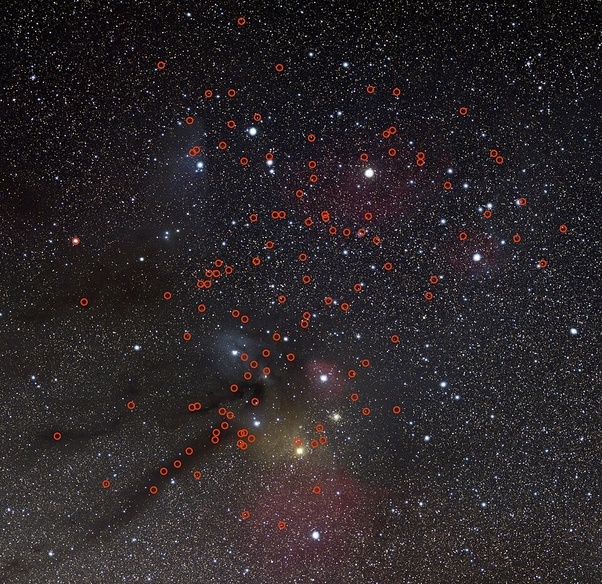
Image credit: ESO/N. Risinger (skysurvey.org)
In 2021, a research team lead by Núria Miret-Roig, an astronomer at the Laboratoire d’Astrophysique de Bordeaux, France and the University of Vienna, Austria, detected between 70 -170 rogue planets within a region known as the Upper Scorpius young stellar association. Although rogue planets can generally only be detectable through microlensing techniques, these “free floaters” are still quite young, and therefore warm and consequently can be directly detected by their heat emissions. Here again, the actual number of rogue planets is uncertain as some of the circled objects could very well be brown dwarfs.
Astronomers hope that the Nancy Grace Roman Telescope, due to launch at the end of this month (August 2026), will be able to detect thousands of rogue planets through the use of microlensing techniques. While this new space telescope will certainly not be able to find even 1% of all rogue planets that we suspect are lurking in the galaxy, it will at least tell us if rogue planets are as common as many astronomers believe them to be.

*Some astronomers have speculated that some rogue planets might still contain atmospheres. A recent paper [Schulze-Makuch and Drake, 2021] even suggested the possibilty that some rogue planets could harbor microbial life forms that might even be involved in the dissemination of life throughout the galaxy as described by the Panspermia Theory.
This answer originally published on Quora.


Leave a Reply