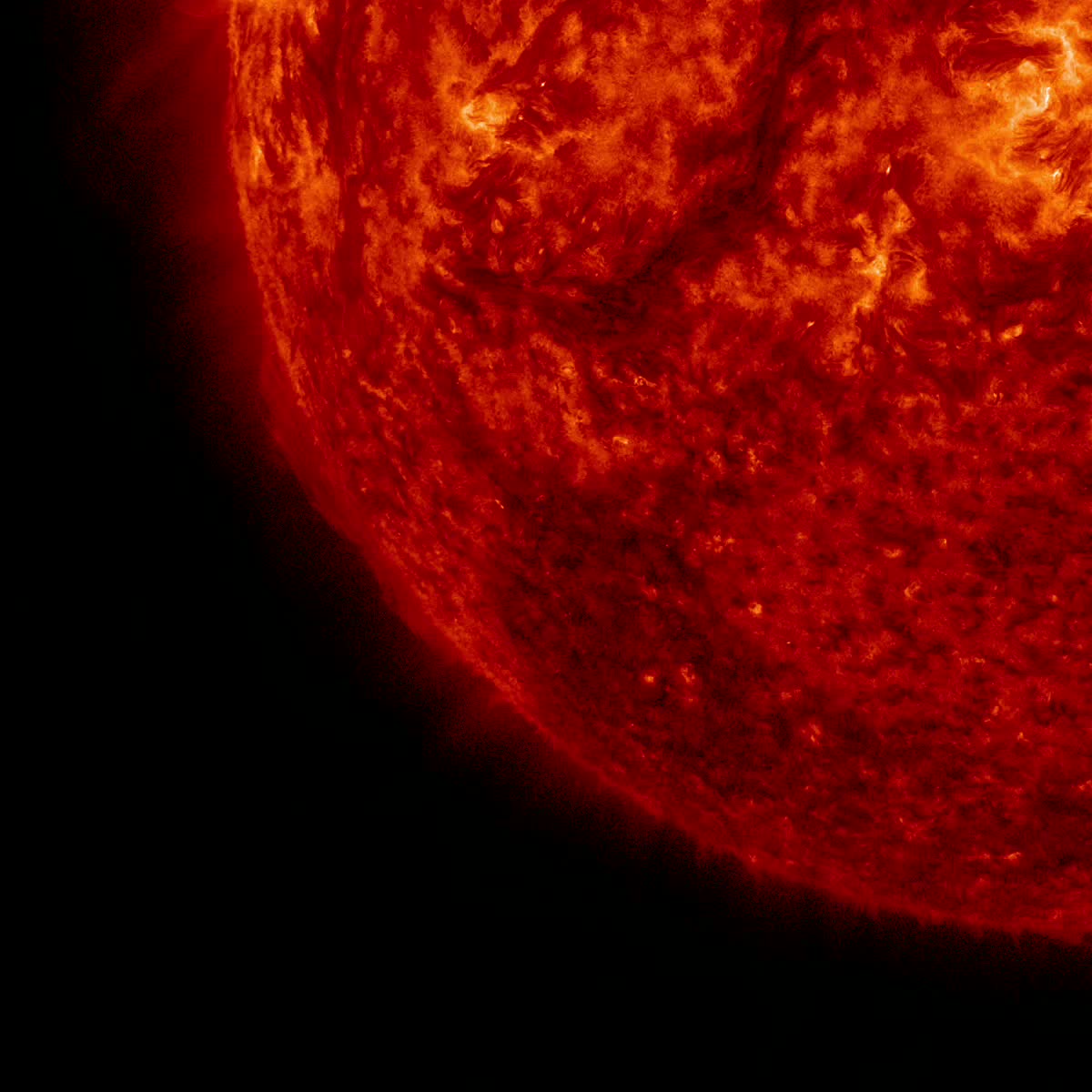
Today, as we enjoy a drizzly, dark and dreary day tucked away on our ocean island, we celebrate the Sun, wherever it may be.
Explanations of the Quiz Answers:
1. How many Earth-sized spheres could fit inside the Sun?
c. 1.2 million. The Sun is enormous. It accounts for more than 99% of all the matter within the solar system. The rest of the material, including the planets, are mere afterthoughts. It is the furiously hot furnace imparting copious energies on its attendant worlds.
2. What is the Sun’s rotation period?
d. 24.5 days at the equator; 38 days at the polesThe Sun isn’t solid and therefore rotates differentially: the rotation speed depends on latitude. The Sun’s gases are rapid movers along the equator, but are more lethargic at either pole.
3. The Sun formed with many other stars, perhaps more than a thousand. They were all part of a galactic cluster that slowly dissipated. How many of these “sibling stars” have astronomers identified so far?
c. 2 HD 162826 in Hercules and HD 186302 in PavoAstronomers expect to find many more of the Sun’s siblings by examining stars with similar chemical compositions and orbital trajectories.
4. The Sun–and its attendant bodies–revolve around the galaxy at about 143 miles per second. How long (approximately) does the Sun require to complete one orbit around the Milky Way?
c. 225 million yearsA “galactic year” is the time the Sun requires to complete one orbit around the Milky Way Galaxy. This precise duration is uncertain. Astronomers estimate, however, that the galactic year is about 225 million years long. By this standard, one could say that the non-avian dinosaurs were Earth’s dominant life forms a year ago.
5. The Sun, like other stars, emits radiation along all the wavelengths of the electromagnetic spectrum. Each star also has a “peak wavelength,” at which the Sun produces its maximum amount of radiation. Along which part of the EM spectrum is the Sun’s peak wavelength?
a. in the blue-green section
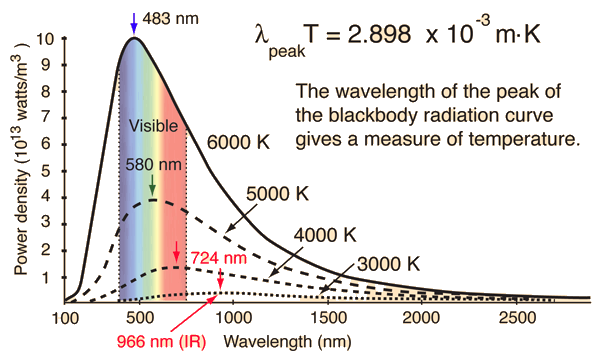
Wein’s displacement law relates a star’s “effective” temperature and the wavelength of its peak emission. The Sun’s peak wavelength is around 500 nanometers, within the blue-green section of the EM spectrum. NOTE: The Sun isn’t yellow! If seen in space it would actually appear to be white. The yellow coloring is a result of atmospheric light scattering.
6. What is the name of the solar probe that in April 2021 came closer to the solar surface than any other spacecraft?
b. Parker Solar Probe. Launched in August 2018, this probe first flew through the solar corona in December 2021 and has made multiple close passes since then. Its closest approach to date is 3.8 million miles from the solar surface.
7. The Sun is currently fusing hydrogen into helium in its core. Approximately how much hydrogen is fused each second?
d. 647 million tonsThe Sun fuses hydrogen into helium. In the process, some of the original hydrogen is converted into energy.
8. How long will the Sun’s core hydrogen supply last?
c. 5 billion years. This hydrogen depletion won’t destroy the Sun. Instead, the Sun will be powered by core helium fusion reactions. Long before the Sun exhausts its hydrogen reserves, it will become far too hot to sustain life on Earth.
9. When will the Sun explode as a supernova?
d. Never. The Sun is not nearly massive enough to explode as a Type II supernova. Only stars at least nine times as massive as the Sun will end their life cycles as supernovae.
10. How distant is the nearest “Sun-like” star (here defined as being spectrally similar and without any stellar companion)?
a. 12 light years. About 78% as large as the Sun, Tau Ceti is the nearest of the “Sun-like” stars, or those that have a similar chemical composition. Five planets are known to be in orbit around Tau Ceti. Two of these worlds revolve within the star’s habitable zone, making them of particular interest to alien-seeking astronomers
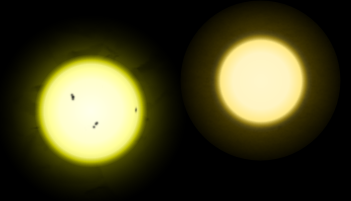
The Sun and Tau Ceti. Our star is to the left and Tau Ceti is to the right. In this artistic depiction, we can readily observe that Tau Ceti is the smaller of the two stars.




Leave a Reply