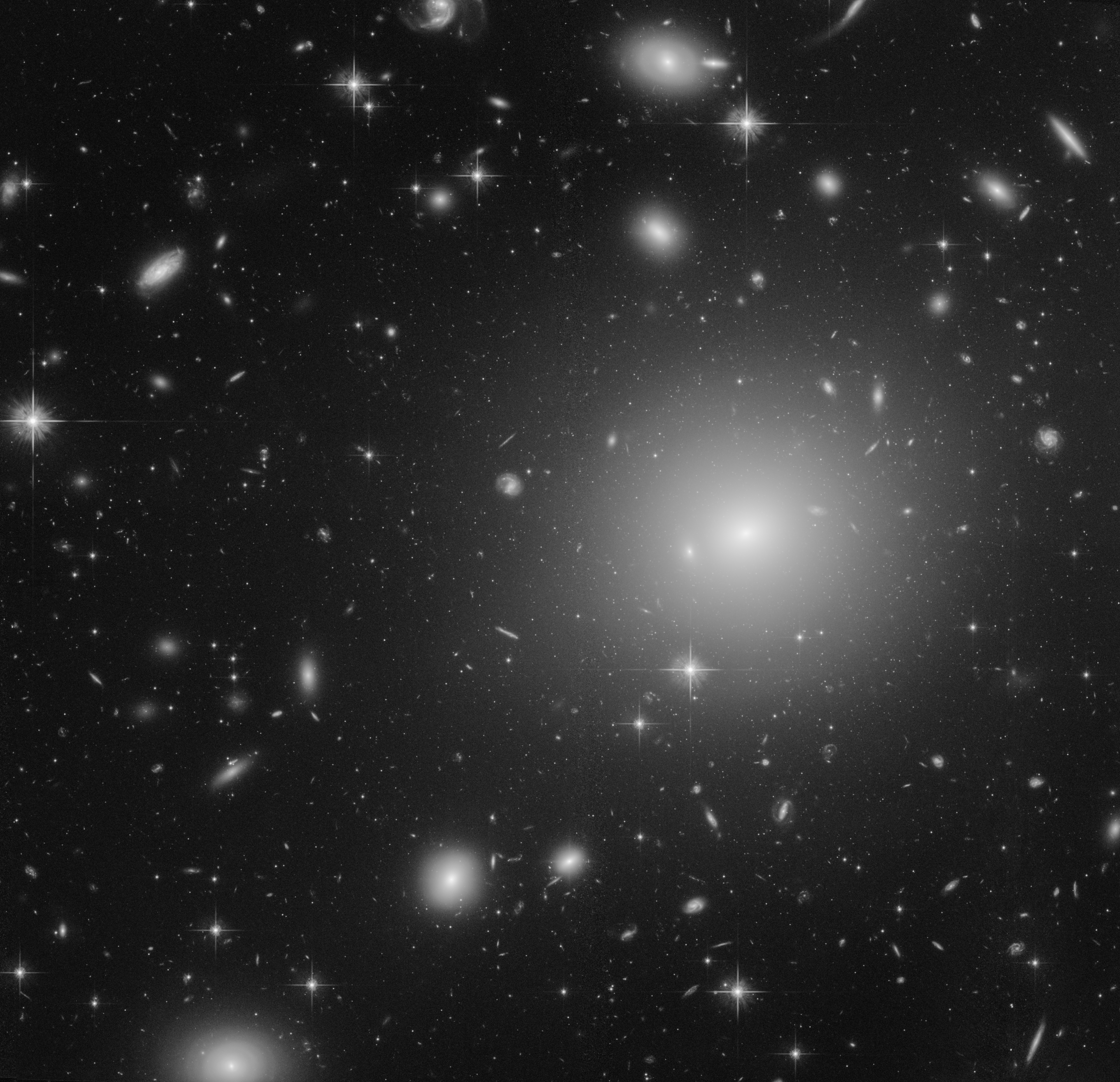
The Milky Way Galaxy and the Local Group of Galaxies to which it belongs are moving in reference to the Cosmic Microwave Background at the speed of 630 km/second (1.4 million miles per hour). In a paper published in 2017 in Nature Astronomy, a research team headed by Yehuda Hoffman explained that the Milky Way Galaxy’s motion through space results from both attraction to the Shapley Concentration and repulsion by what is known as the Dipole Repeller.
The Shapley Concentration, or Shapley Supercluster, is a large concentration of two dozen massive galaxy clusters, the center of which is located approximately 652 million light years from the Milky Way. In the image below, we can see the Shapley Concentration toward the upper right with the Milky Way’s position noted at the lower left.
The Dipole Repeller Void is a vast region of low density, the center of which is located approximately 717 million light years from the Milky Way. The Milky Way and the other galaxies contained with the Local Group experience both the attraction to the Shapley Supercluster and the Repulsion by the Dipole Repeller.
The complex graphic above shows the Local Group between the attracting Shapley Supercluster and the repelling Dipole Repeller. It bears mentioning, however, that as far as we know, gravity is invariably attractive. The “repulsion” induced by the Dipole Repeller is likely just a lack of counterbalancing pull.
According to these studies, the Milky Way Galaxy isn’t moving around anything, but, along with its Local Group companions, is being drawn toward a region of galactic over density within the Centaurus region.


Leave a Reply