Remember that famous fictional Danish character who once marveled at human beings?
“In action, how like an angel! In apprehension, how like a god? Infinite in faculty,” et cetera, et cetera…
Well, a perfect example of that infinite faculty swaggered into the star dome a couple years ago and and asked, “When will humans rule the galaxy?”
That earnest little boy of cherubic appearance and nine harsh winters appeared almost luminous with excitement. Not wishing to be a middle-aged wet blanket, I confidently replied, “Oh, certainly in your lifetime.. Don’t neglect your math homework.”
The real answer, which I will post here because I know that you’re made of metals stronger than Earth, is:
Humans will govern the galaxy the day after an amoeba takes a seat on the UN Security Council.
In other words, never. For all our traits, both laudable and detestable, humans, even when taken en masse, are far too teeny to ever exercise any political influence over the galaxy, let alone reign over it. That we can even harbor an ambition to become galactically dominant speaks as much to our ignorance of the Milky Way ‘s proportions as to the irrational ambitions that impel us to conquest and destruction.
We understand that “saving the galaxy” or “enslaving the galaxy” is a common theme in science fiction movies and novels. So many space-faring paladins from Captain Kirk to the Silver Surfer have often saved the galaxy from ruin and collapse. And, though we don’t wish to seem unappreciative, the notion of any one human -or superhuman- wielding such power is as preposterous an idea as a seventh Platonic solid in 4-dimensional hyper-space.
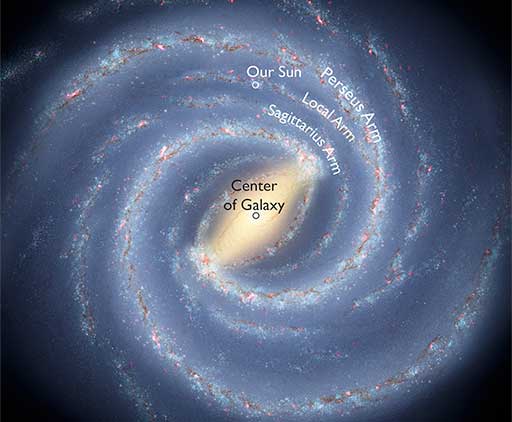
The Milky Galaxy, an artistic depiction of which is seen below, is so monstrously huge as to defy all comprehension. We try to convey its size with some analogies. First of all, if we could construct a scale-model map of the Milky Way that covered all of North America, our solar system would fit neatly into the solar system. On that map, one would need a low power microscope to observe Earth.

If that one model doesn’t serve to explain the Milky Way Galaxy’s vastness, we’ll try another. From dusk to dawn, one could count about 10,000 individual stars without the aid of a telescope. One could draw 10,000 little black dots on a longer sheet of paper measuring 8.5″ x 14,” Those dots would represent all the stars visible to the naked eye during one night. In order to draw enough dots to represent all the stars in the Milky Way, one would need a sheet of paper measuring 8.5″ by 8,838 miles! Imagine driving down the eastern seaboard next to that immensely long piece of paper. Since yours is a fervent imagination, envision driving alongside Julius Caesar. You can jerk your thumb toward that 8,838 mile long column and say, “No worries. You’ll never run out of worlds to conquer.” (You can also imagine that he understands English and won’t insist on driving, himself.)
Before we contemplate galactic conquest, we should at least travel half a million miles away from Earth. So far, no human has even ventured half that distance. The three crew members of the ill-fated Apollo-13 mission still hold the human distance record. They reached a distance of 248,655 miles from Earth on April 14, 1970. Alien abduction victims apart, nobody has ever gone farther away from Terra Firma than the Apollo-13 crew.
Well, we have sent robots farther away. Yet, by galactic standards, they’ve barely crossed the bedroom threshold. Voyager 1, the most distant of our robotic probes, is now 15.3 billion miles away and increasing its distance by 37,800 miles every hour. Even that far flung probe will need 17,460 more years to even travel one light year, less than one-fourth the distance to the closest star Alpha Centauri.*
I think we can all agree that we might want to abandon the ambition of Galactic rule, at least for now. That sad reality is particularly unfortunate for the Milky Way, as humans have clearly demonstrated a supernatural capacity for both efficiency and wise governance. All the same, we will continue to mislead today’s youth with hubristic dreams of galactic conquest. They’ll learn in time that such mad ambitions shall go forever unrealized. That’s fine, though. Humans always handle disappointments philosophically.
*And, it isn’t even traveling in Alpha Centauri’s direction!




Leave a Reply