
How often have we been out here on these sublimely beautiful nights and seen bedazzled souls staring reverently up at the unbounded infinitude? Enraptured by the ethereal beauty and humbled by the grandeur of a Universe that will persist for trillions of years after their ephemeral human lives flame out. And, yet we must wonder: Within these mesmerized throngs of Earth-bound skywatchers is there no hot-blooded figure red in tooth and sharp of claw who isn’t smirking at the celestial firmament and saying, “How we can exploit the devil out of that?”
Well, being resource-craving barbarians at heart, we’re already looking covetously at those tumbling and tantalizingly close mineral-rich asteroids. Perfect outer space fodder for the portfolio feeders, what with their delicious troves of gold, cobolt, osmium, platinum, ruthenium, tungsten and who knows what other precious and semi-precious metals tucked neatly away in their nooks, crooks and crannies.* Consequently, the concept of asteroid mining, though still hypothetical, is very much on the minds of many.
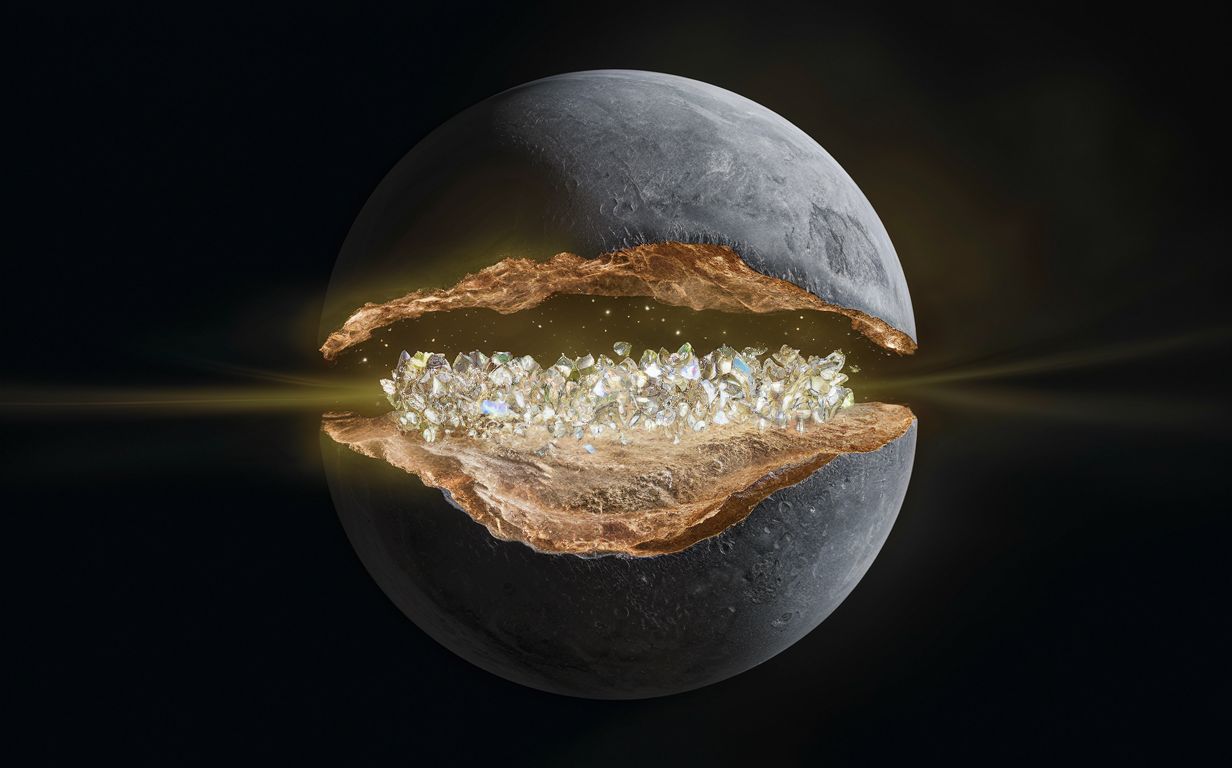
Since we’ll be avariciously venturing into the wild black yonder for loot, gain and plunder, anyway, we might also want to visit Mercury, the first planet from the Sun. There, hundreds of miles under the parched, hell-hot surface we might literally find a dragon’s worth of diamonds: a wide expanse of crystallized carbon 10 miles thick lying between the Mercurian crust and mantle. The estimated value is, well, utterly inestimable: well beyond the bounds of reason and common decency. If, of course, it actually exists.
Let’s begin with the MESSENGER (MErcury Surface Space ENvironment GEochemistry and Ranging) mission. It was launched in August 2004 and established an orbit around Mercury in March 2011. Over the next four years, it completed myriad orbits around the planet and completely mapped its surface before crashing down onto it on April 30, 2015. The observations of Mercury enabled scientists to develop a more accurate model of the planet. As often happens, these observations lead to just as many questions as answers. In fact, Mercury has been something of a puzzle to planetary geologists with its dense core and unusually dark surface. Along this surface one will find large patches of graphite, a type of carbon. These patches are so extensive and numerous that many planetary scientists believe that Mercury could have been a carbon-rich world from its formation: carbon that still remains within the planet in various allotropes.
In a paper recently published in Nature Communications and entitled “A Diamond-Bearing Core Mantle Boundary of Mercury,” a research team led by Chinese astronomer Yongjiang Xu explained that during the differentiation process, the time early in the planet’s history when the materials settle into different layers according to their respective densities (light above, heavy below), the boundary between the core and the mantle should have crystallized into diamond due to the extreme pressures. As diamond is less dense than many of the surrounding metals, it would have risen higher in the planet’s interior and eventually settled in a region more than a hundred miles below the surface: A 10-mile thick layer of diamond perhaps spanning the planet from pole to pole.
The notion of a diamond layer within Mercury is not based solely on MESSENGER data. The team also relied on thermodynamical models and a special “press” capable of replicating the conditions that prevail within Mercury. Through experiments with this press they determined that those conditions were conducive to the formation of diamond material in great abundance.
Before we embark on an extraction expedition we should take into account not only the prohibitive expense of interplanetary travel, but the infeasibility of mining material so far down on a world millions of miles away. We should remind ourselves that humans have not ventured more than a quarter of a million miles from Earth. Granted, we could, and probably eventually will, deploy robotic craft to do the digging. However, we still lack the technological sophistication that such an enterprise would require.
We’ll have to content ourselves for now with the diamond stores scattered along the service of this planet. Not to worry, though. If history is any guide, when we do possess all the requisite technology, we’ll begin the extractions and exploitations with unbridled abandon: improving the solar system, just as we’ve improved our home world.
*A little nudge and tickle to any knot of hammer-wielding dwarves on the list. Geologists are still debating whether or not one will find smidgeons of emeralds, rubies and other soul-imperiling gems among the asteroids. As I have at least one geologist, Irwin, on the list, I best say nothing else on this topic lest someone will discover that I’m essentially a fraud.
Today’s quote
“Death is not the greatest loss in life. The greatest loss is what dies in us while we live.” -Norman Cousins


Leave a Reply