

Through the Belt
Since Pandora’s Jar remains tucked away within the Southworth Planetarium’s darkest corner, we have had to start another collection of queries. Happily, we just received a question and will promptly offer what we hope is a coherent and helpful answer. We can fill this new jar later.
“How do spacecraft avoid collisions when passing through the asteroid belt?”
Let’s begin by reviewing some astronomical history. We see Han Solo and his rebel cohorts Leia, Chewbacca and C3PO nestled uncomfortably together in the Millennium Falcon cockpit while their ship is being pursued by a battalion of imperial TIE fighters. Unable to accelerate to light speed due to a damaged hyperdrive motivator, the supremely self-confident -the gods would have described it as hubristic- Han Solo recklessly directs his craft into an asteroid field. Despite 3PO’s dire warning that the “the possibility of successfully navigating an asteroid field is 3,720 to 1,”* Han Solo flies through the asteroid belt, deftly maneuvers his ship above, below and around the tumbling asteroids, evades his imperial pursuers and, as stipulated by contract, survives through the end of the movie. Perfect popcorn moment, that.
Now, please forget that history as we address the question.
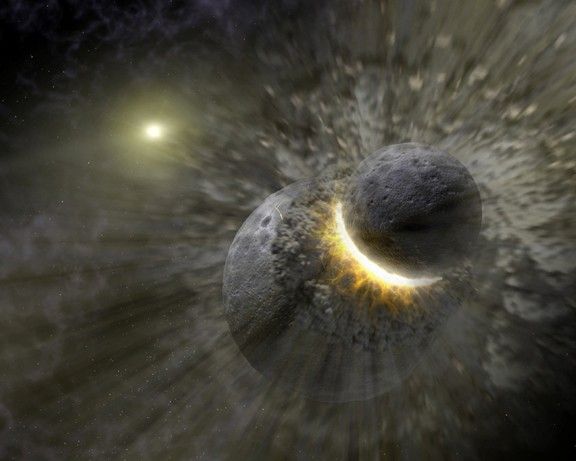
How can spacecraft in this solar system manage to pass through the asteroid belt unscathed? The simple answer is “It’s easy. There’s hardly anything there.”The asteroid belt we encountered in that faraway galaxy a long, long time ago was purely fictional and preposterously over-crowded. The main asteroid belt located between the orbits of Mars and Jupiter is so sparsely populated that spacecraft can pass through it as though it’s empty space. And, honestly, it almost is.
That notion seems absurd because the total population of asteroids in the main belt numbers in the millions. Moreover, it is estimated that the belt contains 1.1 -1.9 million asteroids that are larger than half a mile in diameter. Quite a lot of tumbling rocks darting about. However, if you gathered all those asteroids together to form a single world, the resultant body would be a dwarf planet with a radius of 440 miles. (Pluto’s radius is 693 miles) and with a mass about three percent that of the moon. Also, remember that those bodies are strewn about an immensely large volume. The entire region defined as the asteroid belt encompasses four million trillion cubic miles. Taking these numbers into account, we can determine that the average distance between asteroids is about 600,000 miles.** Even the preternaturally anxious C3PO would be able to calmly tell any space smuggler that “the probability of colliding with an asteroid in the main asteroid belt is 1 in one billion.”
Let’s describe the situation more intuitively. Reduce the Sun to the size of a softball. On this scale, the asteroid belt region would be a wide disc. The inner boundary would be a large circle 76 feet away from the softball-sized Sun while the outer boundary would be 113 feet away. All the asteroids put together would be half the size of a hole made by a paperclip. Now, divide that minuscule hole into millions of much smaller holes and scatter them around that 37- foot wide disc. The result? A highly rarefied asteroid belt.
We should note that the Voyager crafts, the Pioneer crafts, Galileo, Cassini-Huygens all traversed the asteroid belt unscathed. We are confident that future space vessels will be able to pass through it without so much as seeing another asteroid, unless, of course, it’s a craft designed to actually study one of them.

*Yes, I looked up the scene on you-tube. I didn’t remember it off the top of my head.
**This separation distance is a simple average. It doesn’t take into account asteroid families.




Leave a Reply