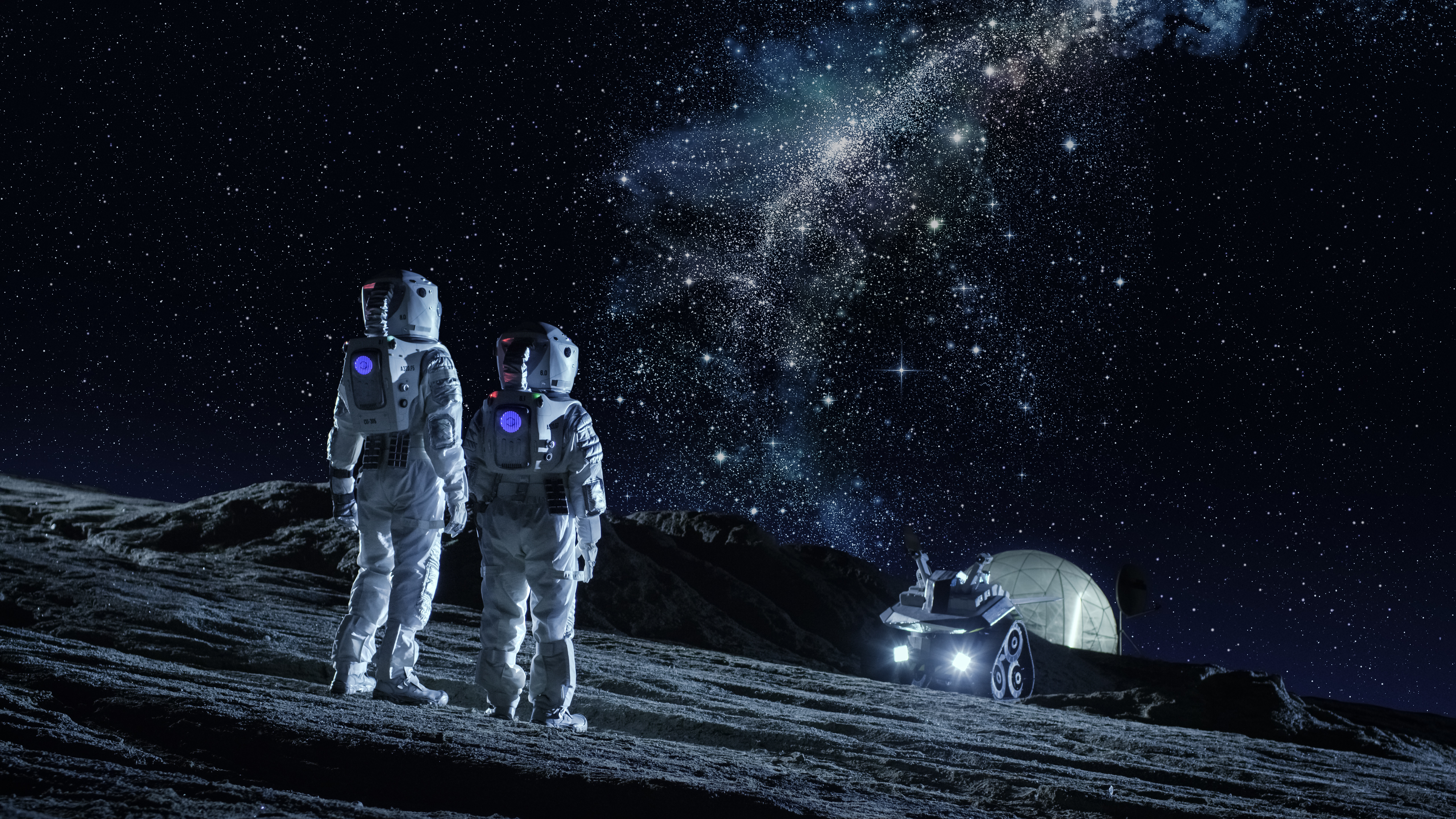
So, Mr. Heinlein, where are our moon bases? It is, after all, 2024: almost a full quarter century after 2001, Sir Clarke. If we had been courteous enough to have abided by the ambitious schedule laid down for us by all those literary visionaries, we’d be darting about in flying cars, conceiving strangely obedient children with androids and, of course, we’d have long since established bases, or even thriving cities, on the lunar surface.
Yet, where are we in 2024? Our cars are still stubbornly Earth-bound. The only obscene thing we’re doing with androids is making calls on them and the moon remains appallingly unpeopled. In fact, the last human to press his prints on the powdery terrain left luna firma more than fifty years ago. What’s taking so long?
Well, first we must make some allowances for our species. We have proven quite adept at sailing for foreign shores when the mood has moved us to do so. We’ve learned how to transport vast quantities of materials around the globe at finger-snapping velocities. (There are more goods in the air and on sea at this very moment than existed in all of 14th-century Christendom.)
Despite the capacities of our ships and the efficiencies of their conveyance, we are nevertheless limited when it comes to celestial excursions. When we travel to the moon, we’ll have to literally bring absolutely everything with us. Not only food, water, toiletries, and pressure suits, we’ll also have to take ample quantities of oxygen and other resources.
Moreover, we’ll have to constantly deliver such goods over the quarter million mile gulf of virtual nothingness that separates the barren moon from the lush, fruit-filled home world. And, quite importantly, we’ll need shelter! Not only to retain the life-sustaining air and to shield us from the punishing temperature extremes, but to also protect us from the barrage of unfiltered solar and cosmic radiation that rains down on the moon like the unassuageable wrath of a malignant Olympian.
Fortunately, Lorenzo Bruzzone and Leonardo Carrer at the University of Trento in Italy have recently located an actual cave under the moon’s surface. With an estimated depth of more than 100 meters, it is deep enough and likely wide enough to accommodate a large crew* of astronauts. Ironically, this cave is relatively close to the very place where astronauts first landed on the moon. This subterranean hollow is located in Mare Tranquillitatis, the same “sea of tranquility” where Neil Armstrong and Buzz Aldrin set down on the moon in 1969. If the first generations of base-building astronauts choose this historically significant terrain to plant their colony, they might have a ready-made shelter on hand, or at least underfoot.
Planetary scientists believe that this cave likely formed millions or billions of years ago, at a time when lava flows running around the more geologically active moon, could have gouged out pits and tunnels just below the surface. Such lava flows might well have formed a large intricate network of such caves and tunnels. Not only could future astronauts find cover in a single pit, they might form extensive underground communities–like a lunar Agartha concealed well below the sun-scorched moonscapes.
Now that scientists have established the existence of this one cave, they will be searching fervently for others. These holes could be the perfect destinations for robotic probes: vessels that could safely wander through these natural catacombs to measure their depths and map out the network. A precursor to the arrival of the first colonists.
Honestly, we don’t know when humans will establish the first lunar base. It could be within a decade, a century or perhaps even later. However, we do know that the boldest of all human enterprises, the construction of human habitation on the moon, might have just become a bit easier.
*There are few linguistic structures more beautiful and pleasing than collective nouns. A congress of ghosts, a tangle of gorgons, a fondle of unicorns, a drudge of skeletons, a vexation of zombies and even an exigency of wendigos. And what collective noun do they come up with for astronauts? A “crew.” Honest to heavens, tell me that’s not as unbearably prosaic as an office clock at 9:05 a.m. Consider this an appeal to the authorities, try again! Or, consider this an appeal to our wonderfully creative subscribers: come up with something else! Spare us the “crew!”
Latest Posts
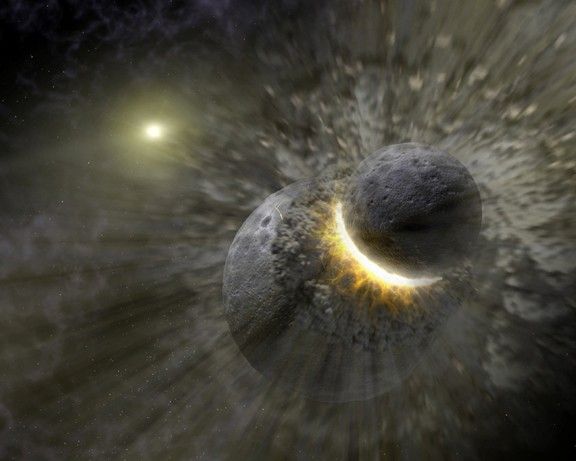
- How Did the Moon Form? The Violent Collision That Created Earth’s Moon
 How did the Moon form? Explore the violent collision that created our lunar companion, its early relationship with Earth, the origin of its phases and tides, and the Moon’s enduring place in human mythology.
 - What is the Drake Equation?
 The Drake Equation attempts to estimate how many communicative alien civilizations might exist in the Milky Way. But with most of its variables still unknown, calculating the answer involves as much educated speculation as mathematics. Here’s what the equation tells us—and what it reveals about our search for extraterrestrial life.
 - Lunar Eclipse Event at Bowring Park, St. John’s, Newfoundland, Friday, August 28, 2026, 12-3 am. FREE!!!
 Join us at Bowring Park for a lunar eclipse event at Bowring Park in St. John’s, Newfoundland, from 12–3 a.m. on August 28, as we gather to observe a beautiful partial lunar eclipse.
 - Mogh Ruith Virtual Planetarium Now Booking School Programs for Fall 2026
 Mogh Ruith Virtual Planetarium is now booking school programs for Fall 2026. Explore the night sky through virtual star tours or share a presentation on the Moon, the secret night sky, or night-sky mythology with your students. Also offering Earth Systems 3209 curriculum support. Each one-hour session includes a question-and-answer period and a night-sky tour, presented by Astronomy Now columnist and veteran planetarium director Edward Herrick-Gleason.
 - Did Dark Matter Kill the Dinosaurs?
 Dinosaurs exercise a strange fascination over humanity, owing, perhaps, to their disproportionate sizes, exotic structures, and temporal remoteness. Some loomed taller than buildings and extended over a hundred feet. They assumed various forms: horned, quadrapedal, duck-billed and even winged. And, the last of the dinosaurs (not counting the ones that evolved into today’s birds) trod… Read more: Did Dark Matter Kill the Dinosaurs?


Leave a Reply