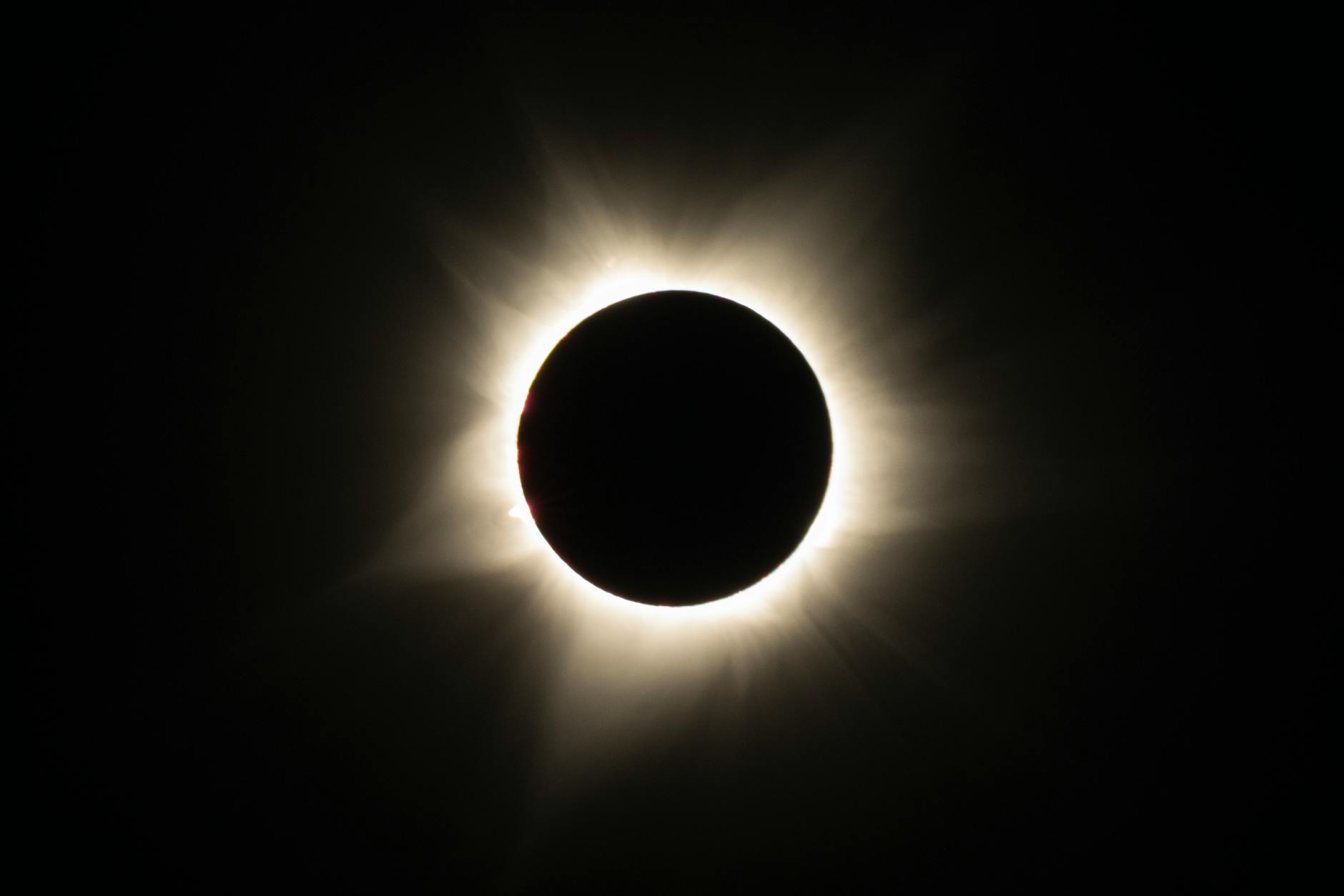
LESS THAN A MONTH UNTIL THE TOTAL SOLAR ECLIPSE!
Now that we are less than one month away from what may well prove to be the most spectacular celestial event of the century, we can resume our eclipse series.
Today we focus on the time table: what observers at certain locations will see and when they’ll see it. We know that the April 8th eclipse will not be total in southern Maine (If it is any consolation, the next total solar eclipse visible in Maine, on May 1, 2079, will be total down here). However, more than 90% of the Sun will be blocked by the moon at maximum. Although the corona won’t emerge and we won’t be able to admire the fine array of Bailey’s Beads, the sky will still darken considerably and should command the attention of all but the most obstinately terrestrial of us.
PORTLAND, MAINE
The eclipse will begin at 2:17:55 p.m. One will observe the faintest hint of a shadow along the Sun’s limb: like an malevolent apparition loitering along one’s periphery. (Or perhaps not).
The eclipse will be maximum at 3:31 p.m. The magnitude will equal 0.964. This value means that the moon will block 96.4% of the Sun’s diameter. Obscuration refers to the percentage of the Sun’s area the moon blocks. When the magnitude exceeds 0.93 it begins to converge with obscuration. The moon will cover about 96% of the Sun’s area, reducing its brightness to about 2.5% of its usual intensity. HOWEVER: do not remove your eclipse glasses even at maximum! They can only be safely removed when the eclipse is total!
The eclipse ends at 4:39:47 p.m. The subtle darkness along the Sun’s limb vanishes and the eclipse draws to a close. By this time, however, the crowds might have long since dissipated.
BANGOR, MAINE
Eclipse begins at 2:20:28 p.m. Notice that even the distance of 150 miles will make a difference in the timing. The eclipse begins about two and a half minutes later in Bangor than Portland.
The eclipse will be maximum at 3:32:55 p.m. Eclipse magnitude 0.987. Bangor will be closer to the totality path than Portland and so the eclipse magnitude value will be higher. Approximately 99% of the Sun’s area will be blocked at maximum, which will reduce the Sun’s intensity to 1% of its usual value. HOWEVER, do not remove your eclipse glasses even at maximum! They can only be safely removed when the eclipse is total!
Eclipse ends at 4:40:44 p.m. Again we see the time difference between Portland and Bangor.
HOULTON, MAINE
Now we venture into the totality path, a region we’ll explore in greater detail in the next post.
Eclipse begins at 2:22:15 p.m. Notice again the time difference as we proceed north
Totality begins at 3:32:06 p.m. Here we see a line that did not appear in the Portland or Bangor sections. At this moment the moon completely blocks the Sun. In a later series article, we’ll explain what an observer will see at totality YES, you may remove your eclipse glasses during totality. Just be sure to put them back on before totality ends!
Maximum: 3:33:46 p.m. The moment at which the Sun is at its most hidden.
Totality ends at 3:35:25 p.m. At this moment the first sliver of the Sun appears. Notice that totality only lasts 3 minutes and 19 seconds. The closer one is to the central path, the longer the totality period will be. Mathematically, the longest total solar eclipse will last 7 minutes, 31 seconds.
The longest totality period…
The April 8th eclipse is part of Saros Cycle 139. Another Saros 139 eclipse, one occurring on July 16, 2186, will produce the longest totality period on record: 7 minutes, 29 seconds, tantalizingly close to the theoretical maximum. Such long eclipses can only occur when Earth is at or close to aphelion, its point of greatest distance from the Sun, and along the equator.
Eclipse ends at 4:41:04 p.m.
The timing, magnitude and duration is all a matter of location. Even small distances can account for measurable time differences. To calculate the circumstances at your location, consult the splendid web-site timeanddate.com.
As the proverb states, “Wherever you go, there you are.”
Next time: Up, down and all around the totality path
Latest Posts
- How Did the Moon Form? The Violent Collision That Created Earth’s Moon
 How did the Moon form? Explore the violent collision that created our lunar companion, its early relationship with Earth, the origin of its phases and tides, and the Moon’s enduring place in human mythology.
 - What is the Drake Equation?
 The Drake Equation attempts to estimate how many communicative alien civilizations might exist in the Milky Way. But with most of its variables still unknown, calculating the answer involves as much educated speculation as mathematics. Here’s what the equation tells us—and what it reveals about our search for extraterrestrial life.
 - IMPORTANT CHANGE–LUNAR ECLIPSE VIEWING WILL BE AT SIGNAL HILL (UPPER PARKING LOT/VIEWING AREA), St. John’s, Newfoundland, Friday, August 28, 2026, 12-3 am. FREE!!!
 Join us at Signal Hill to view the partial lunar eclipse in St. John’s, Newfoundland, from 12–3 a.m. on August 28.
 - Mogh Ruith Virtual Planetarium Now Booking School Programs for Fall 2026
 Mogh Ruith Virtual Planetarium is now booking school programs for Fall 2026. Explore the night sky through virtual star tours or share a presentation on the Moon, the secret night sky, or night-sky mythology with your students. Also offering Earth Systems 3209 curriculum support. Each one-hour session includes a question-and-answer period and a night-sky tour, presented by Astronomy Now columnist and veteran planetarium director Edward Herrick-Gleason.
 - Did Dark Matter Kill the Dinosaurs?
 Dinosaurs exercise a strange fascination over humanity, owing, perhaps, to their disproportionate sizes, exotic structures, and temporal remoteness. Some loomed taller than buildings and extended over a hundred feet. They assumed various forms: horned, quadrapedal, duck-billed and even winged. And, the last of the dinosaurs (not counting the ones that evolved into today’s birds) trod… Read more: Did Dark Matter Kill the Dinosaurs?



Leave a Reply