
We shouldn’t forget that another eclipse will occur later this month! On Saturday, October 14, 2023, to be precise.
As is true with every eclipse, what an observer sees depends on the observer’s location. While those within the totality path will see an annular solar eclipse, other less fortunate sky watchers will be treated only to a partial eclipse, the magnitude of which decreases with increasing distance from the totality path. As we can see from the map below, the totality path begins in the north Pacific, slices across the western and southern United States before meandering across the Gulf of Mexico before gliding majestically over the Yucatan Peninsula , eastern Central and finally across the northern part of South America.

An annular solar eclipse occurs when the moon moves directly in front of the Sun when it is at or near apogee, its point of greatest distance. As the moon will be farther away than usual, its angular diameter (30′ 5.8″) will be smaller than that of the Sun (32’04”). Consequently, the moon will not obscure the entire solar disk. Instead, at ‘totality,’ the moon will appear as a dark circle surrounded by a ring of fire, Mr. Cash. The word ‘annular eclipse’ derives from the Latin word ‘annulus’ meaning ring.

Image credit: : Chayanan Phomsukwisit
Those outside the totality path will not see the ring effect. Instead, only a partial eclipse will be visible. As one can readily infer, during this type of eclipse the moon only blocks part of the Sun. And, one might ask, “Well, isn’t that true of the annular eclipse, as well?” To which we reply, “This explains why lawyers should never write astronomy blogs.”
We here in the Greater Portland area will only see a slightly partial eclipse because we’re quite a substantial distance from the Totality Path. When the eclipse reaches maximum at 1:25 p.m. on Sat, Oct 14th, its magnitude will only be 0.262. Magnitude refers to the percentage of the Sun’s diameter the moon blocks. This value is not the same as the obscuration percentage, which measures the percentage of the Sun’s surface area the moon covers. At the magnitude of 0.262, about 17% of the Sun’s face will be shielded by the moon.
The Time-Table specific for Portland is as follows:
12:21.00 p.m. Partial Eclipse begins
We first see the dark edge of the moon against the Sun
1:25.50 p.m. Maximum Eclipse
The time when the moon covers the maximum amount of the Sun from our perspective
2:30.16 p.m. Eclipse Ends
The moon is no longer seen against the Sun.
You can find the times relative to your location at the following website: www.timeanddate.com/eclipse/solar/2023-october-14.
While this event won’t be dazzling enough to sow superstitious terror amongst the intellectual elites, it does affirm the power inherent in that hurly-burly witchery of mathematical astronomy: humanity’s ability to precisely predict the motions of grand celestial worlds. While we might not exert any influence over the empyreal realm, we can at least know how the celestial orbs interact.
Consider this a mere taste of the feast that awaits us in April.
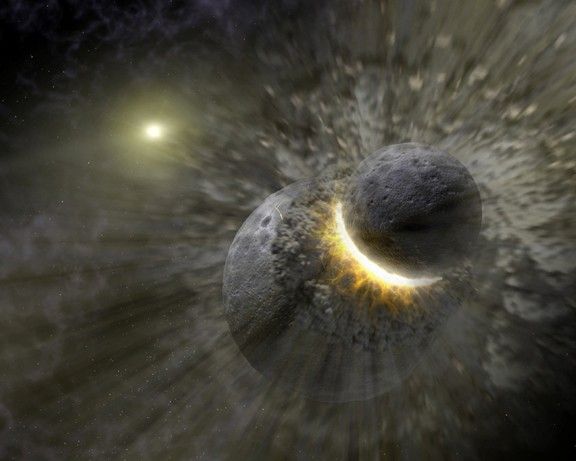
- How Did the Moon Form? The Violent Collision That Created Earth’s Moon
 How did the Moon form? Explore the violent collision that created our lunar companion, its early relationship with Earth, the origin of its phases and tides, and the Moon’s enduring place in human mythology.
 - What is the Drake Equation?
 The Drake Equation attempts to estimate how many communicative alien civilizations might exist in the Milky Way. But with most of its variables still unknown, calculating the answer involves as much educated speculation as mathematics. Here’s what the equation tells us—and what it reveals about our search for extraterrestrial life.
 - IMPORTANT CHANGE–LUNAR ECLIPSE VIEWING WILL BE AT SIGNAL HILL (UPPER PARKING LOT/VIEWING AREA), St. John’s, Newfoundland, Friday, August 28, 2026, 12-3 am. FREE!!!
 Join us at Signal Hill to view the partial lunar eclipse in St. John’s, Newfoundland, from 12–3 a.m. on August 28.
 - Mogh Ruith Virtual Planetarium Now Booking School Programs for Fall 2026
 Mogh Ruith Virtual Planetarium is now booking school programs for Fall 2026. Explore the night sky through virtual star tours or share a presentation on the Moon, the secret night sky, or night-sky mythology with your students. Also offering Earth Systems 3209 curriculum support. Each one-hour session includes a question-and-answer period and a night-sky tour, presented by Astronomy Now columnist and veteran planetarium director Edward Herrick-Gleason.
 - Did Dark Matter Kill the Dinosaurs?
 Dinosaurs exercise a strange fascination over humanity, owing, perhaps, to their disproportionate sizes, exotic structures, and temporal remoteness. Some loomed taller than buildings and extended over a hundred feet. They assumed various forms: horned, quadrapedal, duck-billed and even winged. And, the last of the dinosaurs (not counting the ones that evolved into today’s birds) trod… Read more: Did Dark Matter Kill the Dinosaurs?


Leave a Reply