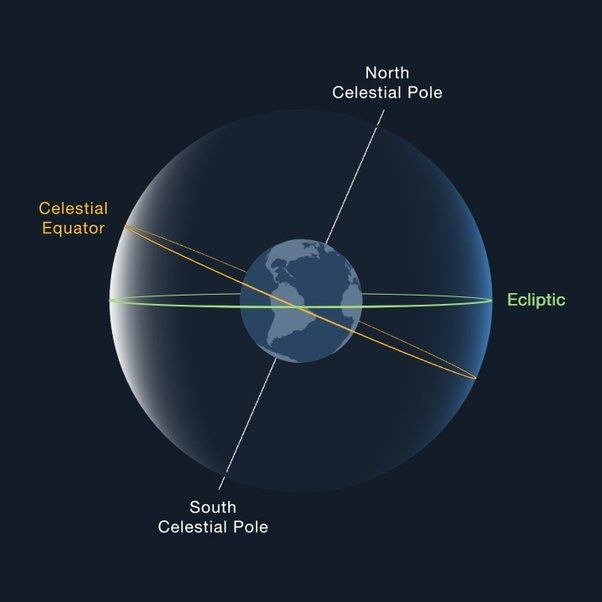
What is the highest star that appears above us, and why?
The answer to that question depends on the observer’s location.
Let’s imagine that Earth is a transparent glass sphere. When one stands on Earth and looks around one notices stars in every direction: just as many below the feet as exist above the head.

Notice that every point on this “Earth sphere” corresponds (in your imagination) to the position of a star. You stare directly overhead, or at the zenith, and you’ll see a specific star at the uppermost position for a moment. As the planet rotates, different stars will occupy the zenith at specific times. Only those stars whose declinations (angles north or south of the celestial equator–the projection of Earth’s equator onto the sky) equal the observer’s latitude will ever see that star pass through the zenith.
Regard Polaris, the ‘north’ star:

With a current declination of 89° 15′ 38.1″ Polaris is not exactly at the north celestial pole, but is so close that an observer at the North Pole would be hard pressed to notice the difference.
As this star is almost aligned precisely with Earth’s north pole, it will just about appear overhead from the perspective of a north pole observer. From this location, at one end of the axis, no other star will appear to occupy the zenith throughout the rotational cycle (one could find stars closer to the north celestial pole than Polaris, but let’s cheerfully neglect them because they’re not prominent.).
Now, regard the star Betelgeuse:

As its declination is about 7 degrees (7° 24′ 26″), Betelgeuse will appear to pass directly overhead from the perspective of any observer located along the 7th North parallel.
Finally, let’s look at the night sky’s brightest star, Sirius:

Sirius’ declination is almost -17 degrees (-16° 43′ 06″). Consequently, it will pass directly overhead along the 17th S parallel. This last statement makes sense as we can see that Sirius appears south of Betelgeuse and so should appear directly overhead along a parallel that is south of the 7th north parallel.
To determine where any given star will pass through the zenith, simply look up its declination. That star will pass directly overhead along the latitude which is equal to that declination.
Latest Posts
- How Did the Moon Form? The Violent Collision That Created Earth’s Moon
 How did the Moon form? Explore the violent collision that created our lunar companion, its early relationship with Earth, the origin of its phases and tides, and the Moon’s enduring place in human mythology.
 - What is the Drake Equation?
 The Drake Equation attempts to estimate how many communicative alien civilizations might exist in the Milky Way. But with most of its variables still unknown, calculating the answer involves as much educated speculation as mathematics. Here’s what the equation tells us—and what it reveals about our search for extraterrestrial life.
 - IMPORTANT CHANGE–LUNAR ECLIPSE VIEWING WILL BE AT SIGNAL HILL (UPPER PARKING LOT/VIEWING AREA), St. John’s, Newfoundland, Friday, August 28, 2026, 12-3 am. FREE!!!
 Join us at Signal Hill to view the partial lunar eclipse in St. John’s, Newfoundland, from 12–3 a.m. on August 28.
 - Mogh Ruith Virtual Planetarium Now Booking School Programs for Fall 2026
 Mogh Ruith Virtual Planetarium is now booking school programs for Fall 2026. Explore the night sky through virtual star tours or share a presentation on the Moon, the secret night sky, or night-sky mythology with your students. Also offering Earth Systems 3209 curriculum support. Each one-hour session includes a question-and-answer period and a night-sky tour, presented by Astronomy Now columnist and veteran planetarium director Edward Herrick-Gleason.
 - Did Dark Matter Kill the Dinosaurs?
 Dinosaurs exercise a strange fascination over humanity, owing, perhaps, to their disproportionate sizes, exotic structures, and temporal remoteness. Some loomed taller than buildings and extended over a hundred feet. They assumed various forms: horned, quadrapedal, duck-billed and even winged. And, the last of the dinosaurs (not counting the ones that evolved into today’s birds) trod… Read more: Did Dark Matter Kill the Dinosaurs?


Leave a Reply