Frightful scenario. Earth’s citizens awaken. Sirens blare. News dire. Asteroid impact impending. Global annihilation imminent. Stocks rise. Run on toilet paper. Shadow grows. Upturned eyes widen. Flaming interloper plummets. Humans scurry frantically and pointlessly. Brace yourself! Bang! Boom! Bam! Primary impact! Landform vaporized. Debris cast skyward. Secondary impacts numerous. Globe catches fire. Tertiary impacts innumerable. Continents tremble. Sun blocked. Photosynthesis halts. Decade-long winter begins. Earth life decimated. Planet recovers. Sun returns. Surviving species subsist and evolve. Skyscrapers excavated. Hyper-intelligent meerkat archaeologists perplexed.
Or, so the story goes. You know the one: the tale of the lethal asteroid careening inexorably toward Earth sounding doom and destruction for all but the hardiest. This scenario, which last occurred about 66 million years ago, dropped the sledgehammer on the dinosaurs and ushered in the rise of the mammals, including us self-important primates.
Could it happen AGAIN?
Well, yes, in fact, it could happen again. In fact, over the course of the next hundreds of millions of years, the probability of such an impact becomes increasingly higher. The consequences of such an asteroid strike could prove catastrophic for any life forms extant at the time. The prospect of such an assault begs the question: Can we do anything to avert the disaster?
Planetary scientists who track and study potentially hazardous asteroids (PHA) once claimed that we could, in theory, divert such an asteroid. Now, following the success of the DART mission, they’re claiming that, in practice, we likely will do so.
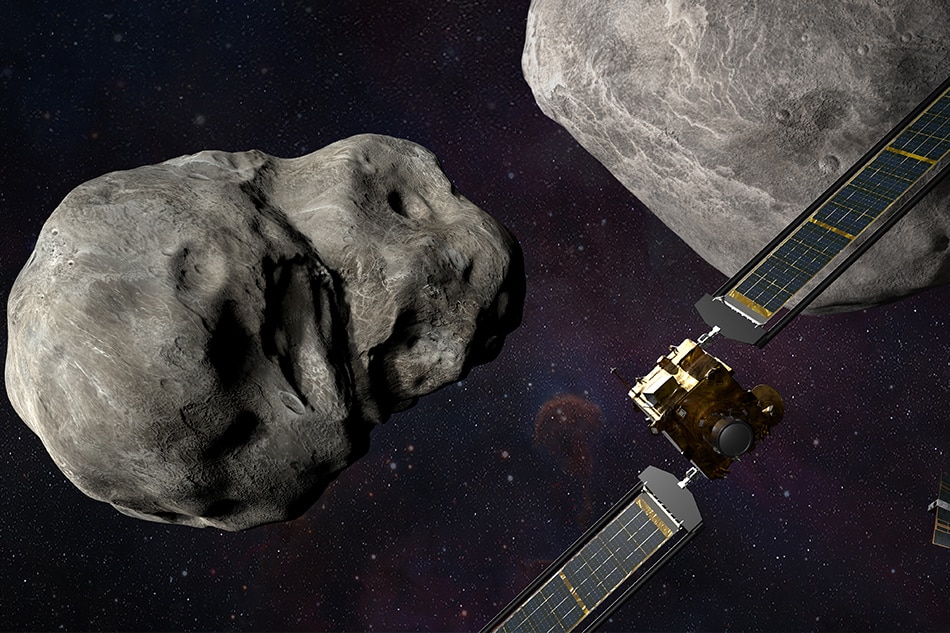
Let’s review: On September 26th, 2022, the golf-cart-sized DART (Double Asteroid Redirection Test) probe crashed into Dimorphos, a 170-meter wide asteroid locked in orbit around its larger companion Didymos. Many watched the asteroid growing ever larger in DART’s camera. Eventually, just as the asteroid’s rubble-lined surface came into clear view, the transmission stopped. The probe smashed into its target, to the exultation of mission scientists! (One of the few spacecraft crashes that ever elicited such a celebration.)
After the probe hit its target, we all waited to see what would happen. Mission scientists hoped that the impact would alter the asteroid’s motion. It certainly did. Prior to the DART strike, Dimorphos required 11 hours, 55 minutes to complete one orbit around Didymos. Now, its orbital period has shortened to 11 hours, 23 minutes! That 32 minute reduction, greater than most estimates predicted, constitutes a resounding success.
Yes, NASA can divert asteroids merely by striking them.
Of course, Dimorphos is much smaller than any asteroid capable of inflicting great harm onto the planet. The asteroid that ended the Cretaceous Period measured about six miles in diameter. However, if such a large asteroid could be struck by a probe early enough, the resultant trajectory alteration could be significant enough to divert its path away from Earth. The Center for Near Earth Object Studies (CNEOS), managed at the Jet Propulsion Laboratory, has compiled an extensive list of PHAs and is tracking them. As CNEOS scientists can predict the probabilities of future impacts far in advance, they should be able to identify any that could potentially strike Earth. If they were to knock that asteroid early enough, its path could be shifted away from our planet.
So far, we know of no large asteroids destined to pummel our world. However, if any such body were discovered, we’d at least possess the means by which to defend ourselves. Whether or not that defense would prove sufficient remains to be seen.
Latest Posts
- How Did the Moon Form? The Violent Collision That Created Earth’s Moon
- What is the Drake Equation?
- IMPORTANT CHANGE–LUNAR ECLIPSE VIEWING WILL BE AT SIGNAL HILL (UPPER PARKING LOT/VIEWING AREA), St. John’s, Newfoundland, Friday, August 28, 2026, 12-3 am. FREE!!!
- Mogh Ruith Virtual Planetarium Now Booking School Programs for Fall 2026
- Did Dark Matter Kill the Dinosaurs?


Leave a Reply