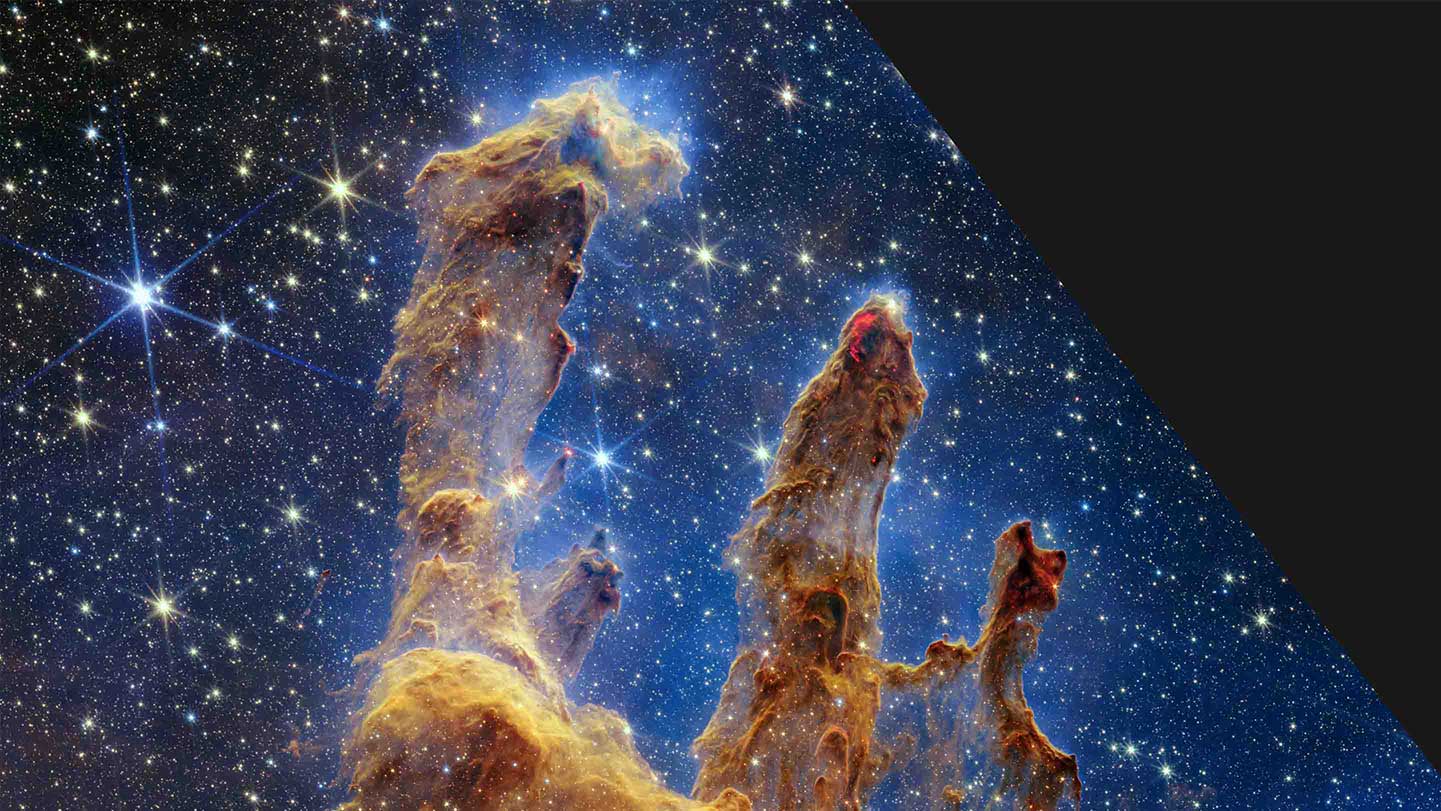
Astronomers have divided the Universe into five distinct ages, or, if you prefer, eras:
- the primordial
- the stelliferous
- the degenerate
- the black hole
- the dark
As the titles imply, the Universe passed through a beginning, is moving through a period of constant star birth (the stelliferous), but will eventually decline to the point at which even the supermassive black holes scattered throughout the cold remnants of a dying universe will perish into oblivion. It is the ultimate example of a celestial Götterdämmerung in which nature’s most magnificent and complex constructs will be cast asunder for all eternity, which, as its name implies, represents an interminable time period.
However, before you cue the requiem music and lapse into a state of hopeless despondency, take heart, for this Stelliferous Era will last a while. How long will it persist? About 100 trillion years. Yes, that value is so large as to be completely abstract. Think of it this way. Our Universe formed about 13.8 billion years ago. The first stars formed about 200 million years after the cosmos was born. If we compress the period between the formation of the first stars and the present into the space of a single week, the entire Stelliferous Era will continue for another 140 years!

Even though we’re living in the earliest part of the Stelliferous, the cosmos is already cranking out stars at a prodigious rate. Every single second, 4800 stars ignite. By this statement we mean that every second 4800 protostars manage to ignite and sustain the thermonuclear fusion reactions that power stars. We add a night sky’s worth of stars to the Universe every 2.2 seconds. Since planet formation seems to be a natural consequence of star formation, we can assume that tens of thousands of planets will eventually form around those 4,800 stars.*

We all know that so much has already transpired throughout time in order to place us living beings on this one world in orbit around a somewhat average star. Millions of years to form the solar system; billions of years to evolve from the earliest prokaryotic cells. And, yet, in Universal terms, even at the end of the Sun’s life cycle six billion years from now, the era of furious and unrelenting star formation will have only just begun.
*A disquieting corollary to this statement. If only 0.01% of those stars end up with a life-bearing planet, we’ll essentially add 41,472 such life worlds to the Universe every Earth day.


Leave a Reply