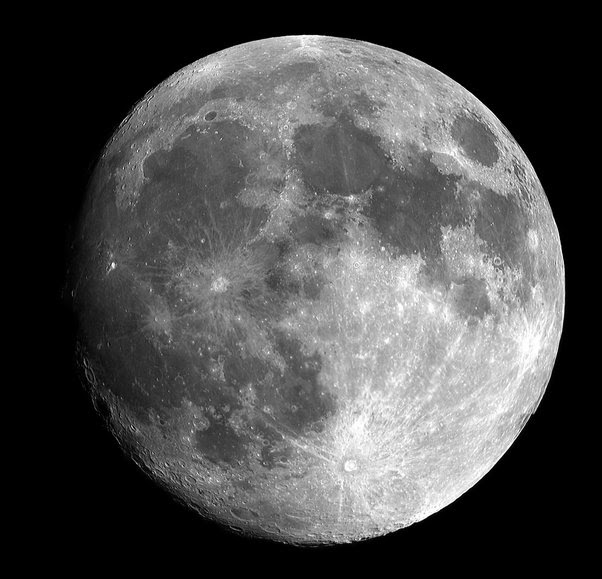
On today’s Pandora parchment the following question was inscribed:
‘If the moon is always half lit up, why does its apparent shape constantly change?’ -B.P., Telford, UK
We observe lunar phases because the moon, which is always 50% illuminated, revolves around us, altering our perceptions of it.
However, let’s suspend physical laws and pretend that the moon maintains its same position in its orbit. For instance, let’s place the moon at Earth’s far side relative to the sun:

During this phase, called opposition, the entire illuminated half of the moon is directed toward Earth. Consequently, the lunar disk appears wholly illuminated:

We see a full moon. If the moon stood still, each night we’d see a full moon.
Now, let’s shift the moon’s position so that it occupies a fixed position between the moon and Sun.

If the moon maintained this position, its illuminated half would always be directed away from Earth and would always remain in the phase called ‘new moon’ or conjunction.

The moon doesn’t remain in the same position, but instead revolves around Earth continually. As a result, we see varying amounts of the moon’s illuminated half.

The percentages are:
- 0% conjunction: “New moon”
- 50% first quadrature: “First quarter moon”
- 100% opposition: “Full moon”
- 50% second quadrature: “Third quarter moon”
The phases occur simply because the moon remains half illuminated while it describes an orbit around our planet.


Leave a Reply