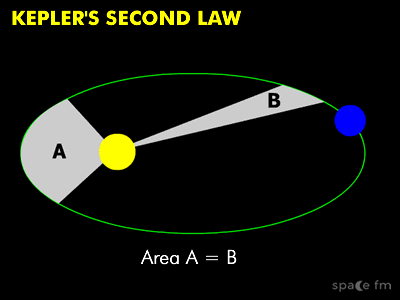
Johannes Kepler (1571–1630) devised what are now considered to be the three fundamental laws of planetary motion. He discovered these laws through painstaking analysis of Tycho Brahe’s extensive and meticulous observations of the planet Mars. Although these three laws serve as the foundation of planetary astronomy, they have often proven confusing. Today, we’ll attempt to explain these all-important rules despite their perceived complexity.
1. Every planetary orbit is an ellipse with the Sun at one focus.

Prior to the development of Kepler’s first law, planets were thought to have traveled along perfectly circular orbits. Kepler realized that these orbits are elliptical. What’s the difference? To explain, imagine that you and a friend are trapped within an ellipse. The image above shows it to be slightly oval-shaped. (Ellipses can actually be circular, oval-shaped, or shaped like a tautly stretched elastic. See first footnote.) Within the ellipse are two dots spaced apart along a line connecting the two diametrically opposed points along the ellipse’s horizontal center. The dots are the ellipse’s foci and the horizontal line is the major axis. Your friend stands on one dot and you are stationed on the other. You are now going to play a game. You each have to walk along a straight line toward any point on the ellipse. Once you touch the ellipse, you must then walk in another straight line toward the other person’s dot in such a way so that your walking distance is less than that of your friend’s. Let’s assume that despite the deep affection you might harbor for each other, you are nonetheless fiercely competitive and spend the entire day walking back and forth. You both find much to your chagrin that you are always tied. The straight line distance from each focus to any point on the ellipse and then back to the other will always be the same.
Even if you space the dots far apart, the sum of these distances will remain the same. The only change will be in the shape of the ellipse. It will become more elongated. Now, you could also merge the dots so that they occupy the same point. Now, you have a perfect circle: the distance between this central dot and any point on the ellipse will be constant.
Kepler’s law places the Sun and one of these foci while the planet travels along its own elliptical path. This discovery was quite revolutionary because even the heliocentric (Sun-centered) model proposed by Nicolas Copernicus retained Ptolemy’s circular orbits. The introduction of the ellipse greatly improved the accuracy of the predicted planetary positions.
2. The radius vector connecting the Sun and a planet sweeps out equal areas in equal intervals of time.

I’ll rephrase it: the closer a planet is to the Sun, the faster it moves. Let’s now imagine a wire connecting Earth and the Sun. For any interval of time, the area Earth sweeps out in its orbit is equal to the area it sweeps out at any other given time. At times, Earth is close to the Sun, at a position called perihelion and at others it is farther from the Sun, a position known as aphelion. No matter where Earth is in its orbit, the amount of space its orbit sweeps out equals that swept out at any other time provided the time intervals are equal. A planet moves fastest when at perihelion and slowest when at aphelion.
[Note:Isaac Newton showed that Kepler’s second law was a consequence of the conservation of angular momentum. The same law that explains how skaters can move more quickly when they draw in their arms.]
3. The Harmonic Law (please bear with me): The square of a planet’s orbital period is proportional to the cube of its semimajor axis.

P = the amount of time a planet requires to complete one orbit around the Sun
a = the planet’s average distance from the Sun, otherwise known as the semi-major axis (or half the major axis we encountered when discussing Kepler’s first law)
If we measure the planet’s period (P) in Earth years and the average distance (a) in Astronomical Units (AU) the proportionality becomes an equality. In other words, one doesn’t have to insert any other value into the formula. [Astronomical unit = Earth’s mean distance from theSun, approximately 93 million miles.]
Just by knowing the amount of time required for a planet to complete one orbit, we can know its average distance. Let’s use Jupiter as an example:
- Jupiter’s orbital period: 11.86 Earth years. (11.86)^2 = 140.6. The cube root of 140.6 equals 5.2. So, Jupiter’s average distance is 5.2 AU
[We should note that Kepler never knew the actual separation distances between the Sun and planets. He simply knew the distances in relation to each other. The first determination of the Astronomical Unit would not be made until the 1760’s.]
*We use eccentricity (e) to measure an ellipse’s departure from circularity. *
- an ellipse with e = 0 is a perfect circle
- e = 1 is a parabola
- e > 1 is a hyperbola
Earth’s orbital eccentricity is 0.0167: very slight. If one could draw Earth’s orbit, it would appear almost circular. The orbital eccentricities of the other major planets save, perhaps, Mercury’s (0.205) are also low
and would also appear circular (Venus 0.006; Mars 0.093; Jupiter 0.048; Saturn 0.054; Uranus 0.047; Neptune 0.008
**These are average values. Planets will move faster when they are at perihelion (the point of least separation distance between a planet and the Sun) than they do at aphelion (the point of greatest distance


Leave a Reply