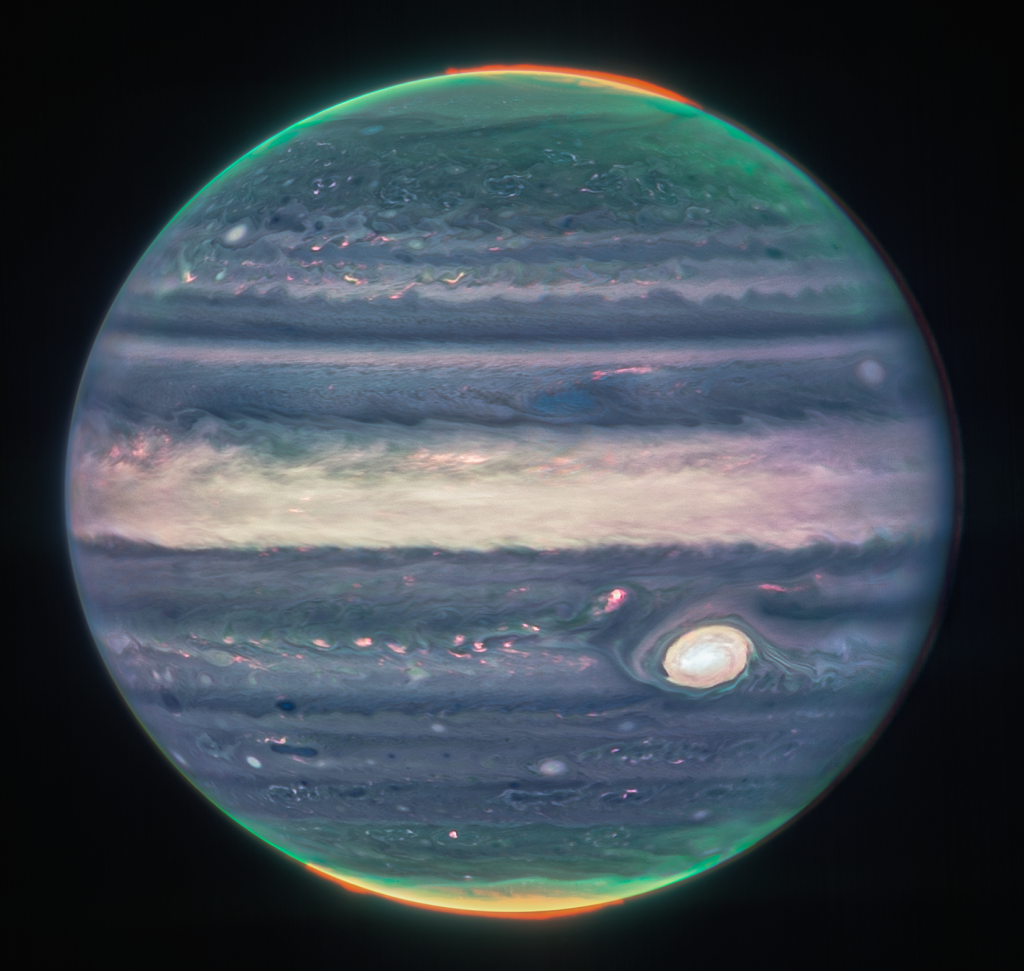

Have you seen Jupiter?! We suspect you have. We should ask: have you seen Jupiter LATELY? If not, please rush outside this evening for a glimpse because it will be well worth the effort. This gargantuan planet is brighter than it has been in about sixty years! Jupiter is that dazzlingly bright orb that begins the evening in the east, progresses through the south around midnight and descends in the western pre-dawn sky. Today’s quiz focuses on this blazing beacon of the eastern evening and western morning skies.
Some questions might seem comically easy, others, less so.
- “Jupiter” is named for the Roman counterpart to the Greek god ____________.
a. Apollo
b. Poseidon
c. Zeus
d. Hades - Approximately how many Earth-sized spheres could fit inside Jupiter?
a. 780
b. 1029
c. 1100
d. 1300 - On average, what is the closest planet to Jupiter?
a. Mars
b. Uranus
c. Saturn
d. Mercury - _________ is Jupiter’s largest moon.
a. Io
b. Europa
c. Ganymede
d. Callisto - How much time does Jupiter require to complete one orbit around the Sun?
a. 5.6 years
b. 7.8 years
c. 11.9 years
d. 13.1 years - Jupiter is at its brightest because it is at “opposition.” Which of the following statements is/are true about opposition?
a. a superior planet is at opposition when Earth passes between it and the Sun.
b. a planet at opposition will be visible all night
c. a planet at opposition will always be moving along a retrograde path
d. all of the above
e. none of the above - Jupiter is about _________ times more massive than Earth.
a. 100
b. 210
c. 318
d. 1100 - When will Jupiter next transit the Sun from Earth’s perspective?
a. 3,490 AD
b. 7,113 AD
c. 13,145 AD
d. none of the above - Galileo Galilei first discovered Jupiter’s four largest moons in the years ________________.
a. 1537-1538
b. 1609-1610
c. 1634-1635
d. Actually, Galileo only discovered two of Jupiter’s moons. Simon Marius, the astronomer who actually gave each of these moons their names, discovered the other two. - True or false? Jupiter is more massive than all the planets put together.
ANSWERS
- “Jupiter” is named for the Roman counterpart to the Greek god __
c. Zeus - Approximately how many Earth-sized spheres could fit inside Jupiter?
d. 1300 - On average, what is the closest planet to Jupiter?
d. Mercury. On average, Mercury is the closest planet to every other planet, including Neptune! Refer to our August 20, 2022, blog post And the Closest Planet to Neptune Is…. - ____________ is Jupiter’s largest moon
c. Ganymede - How much time does Jupiter require to complete one orbit around the Sun?
c. 11.9 years - Jupiter is at its brightest because it is at “opposition.” Which of the following statements is/are true about opposition?
d. all of the above. [Note: a superior planet appears to be moving in a retrograde manner before, during and just after opposition. Imagine being in a fast car that is moving ahead of a slower one. From your perspective inside the faster car, the slower car seems to move relative to the background objects, even though it is still moving forward.] - Jupiter is about _______ times more massive than Earth.
c. 318 - When will Jupiter next transit the Sun from Earth’s perspective?
d. none of the above. Jupiter, as a superior planet–i.e. one farther away from the Sun than Earth– can never transit the Sun from our perspective. - Galileo Galilei first discovered Jupiter’s four largest moons in the years ______________.
b. 1609-1610. Simon Marius did name these four moons (Io, Europa, Ganymede and Callisto), but Galileo was the first to discover them. Or, perhaps more correctly, the first to publish his discovery of these moons. - True or false? Jupiter is more massive than all the planets put together?
False! If you put all the planets together, you have to include Jupiter! Jupiter is more massive–actually twice as massive–as all the OTHER planets put together.


Leave a Reply