by Edward Herrick-Gleason

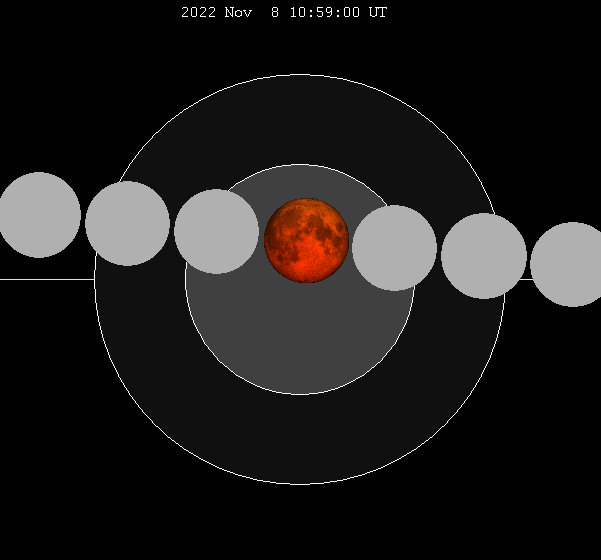
The inner circle represents the umbra, Earth’s inner shadow. The outer circle represents the penumbra, Earth’s fainter outer shadow.
First, the good news: we’re going to experience a total lunar eclipse on November 8, 2022. A total lunar eclipse occurs when the full moon slides sweetly into Earth’s dark inner shadow, called the umbra. When fully immersed the eclipsed moon often glows reddish or, if the gods are in a particularly affable mood, copper-orange. A total lunar eclipse occurred on May 15th, but, as the sky was lamentably overcast, we couldn’t see it. So, it happened, but we didn’t experience it. C’est la vie!
Now, the less-than-good news: the eclipse will start in the wee hours, when even the most fanatical skywatchers have already capped their scopes and slid sweetly into their receiving beds. Mind you, such a spectacular event will likely induce them and even the slightly less obsessive universe admirer to eschew their blankets and remain outside.
Second, more good news! We’ll at least see the moon completely immersed in the umbra before the moon sets!
The second less-than-good news: when the eclipsed moon is low along the horizon, it tends to vanish, rendering it somewhat difficult to observe. Although we’ll likely see the first moments of totality, we won’t see the middle or final moments.
Let’s proceed to the time-line. Although these times are specific to Portland, Maine, the times are other locations nearby will be nearly the same.
PENUMBRAL ECLIPSE BEGINS – 3:02:15 a.m.
Nothing to see here. The moon first touches the penumbra, the outer part of Earth’s shadow. The resultant brightness diminishment is so slight as to be unobservable. While those in possession of superhuman eyesight might be able to notice an obscuration, we mortals would just look upon a full moon as it, well, always appears.
PARTIAL ECLIPSE BEGINS – 4:09:12 a.m.
This is what you’ll likely want to see: the moon first touches the umbra. Now, you can observe the curved shadow moving across the bright lunar disc. During the next hour and seven minutes, the moon will move progressively deeper into the umbra until it is completely covered.
TOTAL ECLIPSE BEGINS – 5:16:39 a.m.
Totality, the time period in which the moon is completely inside the umbra, begins.
MAXIMUM ECLIPSE – 5:59:11 a.m.
The moment when the moon passes through the deepest part of the inner shadow.
MOON SET – 6:32 a.m.
The moon sets from our perspective. Do note, however, that the moon will likely be difficult to see during most of totality, however, due to its low position along the western horizon.
We’ll include the rest of the timetable for completeness:
TOTALITY ENDS – 6:41:36 a.m.
The moon starts to leave the umbra
PARTIAL ECLIPSE ENDS – 7:49:03 a.m.
The moon leaves the umbra. The scarcely visible penumbral eclipse continues
PENUMBRAL ECLIPSE ENDS – 8:56:09 a.m.
The eclipse ends.
Provided the sky is clear, one will be able to at least watch the first phases of this total lunar eclipse. Although the timing might not prove convenient, one should venture outside that morning to snatch at least a quick glimpse. Our next partial lunar eclipse (for us here in Maine) occurs on September 18, 2024. The next total lunar eclipse will happen on March 15, 2025!


Leave a Reply