by Edward Herrick-Gleason
We know that the answer is crouched in a stationary runner’s lunge at the tip of your tongue, so let’s say it together: the closest planet to Neptune, on average, is…
Mercury.
What?!
We saw that furrowed brow and incredulous stare. There you are pensively chewing your thumbnail while muttering, “That can’t possibly be right.” Then, the pause, perhaps a cough while pondering the issue momentarily before saying, “No, that cannot be correct! Mercury is the closest planet to the Sun, while Neptune is the 8th planet. Edward needs more vacation time to sleep it off.”
We’ll state it again: Mercury, on average, is the closest planet to Neptune.
Moreover–and this statement might help–Mercury, on average, is the closest planet to every other planet in the solar system, including Earth.
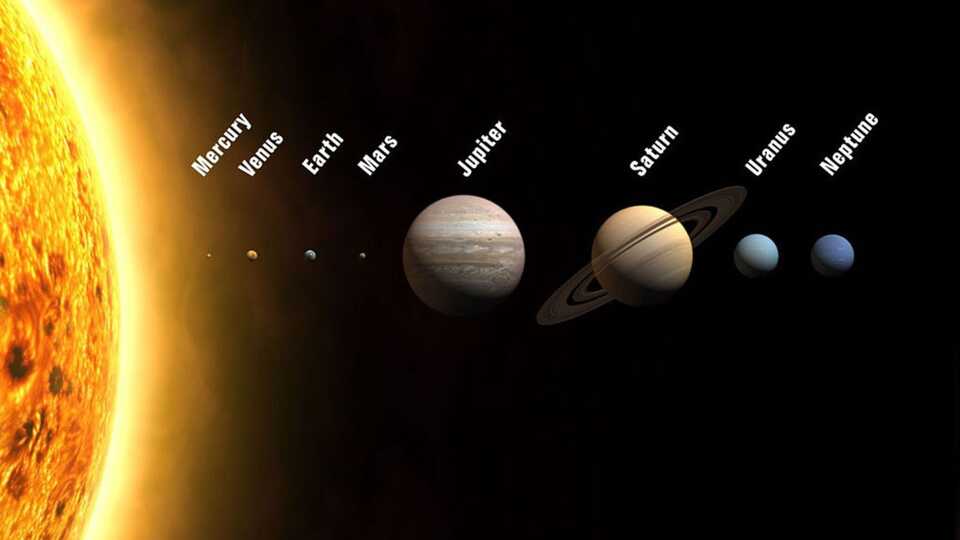
Did that last qualifying statement not offer much help? Well, we’ll try to help and we’ll begin with a solar system graphic you’ve likely seen either in textbooks or on walls at that bastion of youth-corruption known as your local and friendly planetarium.

This is the type of image most people tend to envision whenever they contemplate the planets. All the Sun-orbiting spheres aligned soldier-like next to the Sun. If–and this is a physically impossible if–the planets remained fixed in the above orientation, then the closest planet to Neptune would always be Uranus, the answer that might have tripped off the tongue a few moments ago. Of course, the planets don’t remain stationary, hence the name “planets,” derived from the Greek word “planetes,” meaning “wanderer.” Planets move continually around the Sun. Also, the planetary velocities vary with distance. The planets closer to the Sun move faster than those farther away.** That variation should truly assist us in this following exposition.
For the moment, let’s consider only Mercury, Uranus and Neptune and physically remove the other planets from the space-time continuum. Next, let’s line them up according to the above graphic. The Sun to the left, followed by Mercury, Uranus and then Neptune. Finally, we’ll flick the on switch and let them move at their relative speeds:
Mercury completes an orbit around the Sun every 88 days
Uranus completes an orbit around the Sun every 84.3 years
Neptune completes an orbit around the Sun every 165.2 years
Were we to utilize our time-lapse brain function we’d observe Mercury whipping frantically around the Sun while the two more lethargic gas giants trudge through their orbit at a more glacial pace. Every 88 days Mercury will line up again with Neptune, a configuration known as “inferior conjunction.” At that time, Mercury is generally closer to Neptune than it will be at any other point in its orbit. However, Uranus will only be in inferior conjunction with Neptune once every 171.9 years!
The second point to consider is that Mercury’s maximum distance from Neptune approximately equals 955 million miles. This maximum occurs when Mercury passes to the far side of the Sun relative to Neptune at the time when both planets are at their respective aphelion points, or points of greatest distance from the Sun. However, Uranus’ maximum distance from Neptune, which also occurs at opposite sides of the Sun at aphelions, approximately equals 2.78 billion miles! Because these two planets are such slow movers, they’ll spend decades at a greater distance from each other than Mercury and Neptune.
Finally, remember that we’re referring to averages. At times, Uranus will be closer to Neptune than any other planets. The same could be said for all the other planets, as well. In fact, a research team consisting of members of the Los Alamos National Laboratory, NASA, the US Army Engineer Research Development Center developed a 10,000 year simulation in which they averaged the relative distances between all the planets. They found the following average distances from Neptune over that time-span:
[Note: AU = “astronomical unit,” defined as the average distance separating Earth from the Sun, or approximately 92.96 million miles]
MERCURY (30.071 AU)
VENUS (30.074 AU)
EARTH (30.078 AU)
MARS (30.089 AU)
JUPITER (30.295 AU)
SATURN (30.834 AU)
URANUS (33.119 AU)
Were we to list the average distances of all the planets from every other planet, we’d find that, on average, Mercury is every world’s closest neighbor. In fact, during that 10,000 year span, Mercury was closest to Earth about 46.5% of the time. Venus was the closest planet 36.3% of the time and Mars was closest 17.2% of the time. (None of the superior planets was ever closer to Earth than the inferiors.)
With your leave, let’s post the solar system graphic one more time while succinctly summarizing this article:



Leave a Reply