by Edward Herrick-Gleason
Today, we return to Pandora’s Jar for a question about another type of red-shifting: one that is unrelated to the motion of galaxies.
“I know that galaxies have redshifts when they move away from us. But, why is light from the Sun and other stars and even planets ‘red-shifted?’” -Malcolm. B
Yes, galaxies exhibit a redshift because the light they emit is “stretched out” due to their recessional motion. This elongation causes the light’s wavelength to increase. Because red waves are longer than blue waves, light-emitting objects whose waves experience a motion-induced elongation are said to be “red-shifted.”
However, scientists recognize another type of red-shift known as “gravitational red-shifting.” This red-shifting effect occurs when light moves away from a massive body. That body’s gravitational pull diminishes the light’s energy. Because light speed remains constant, that energy reduction increases the light’s wavelength. A photon’s energy is proportional to its frequency and inversely proportional to its wavelength. The longer the wavelength, the lower the energy.

In theory, every star’s light experiences some gravitational red-shifting because every star is massive. However, that effect is slight. For the Sun, that effect accounts for two millionths of a wavelength. This red-shift is so small it was only finally measured in 2020 by a research team with the Instituto de Astrofisica de Canarias (The Astrophysics Institute of the Canary Islands).
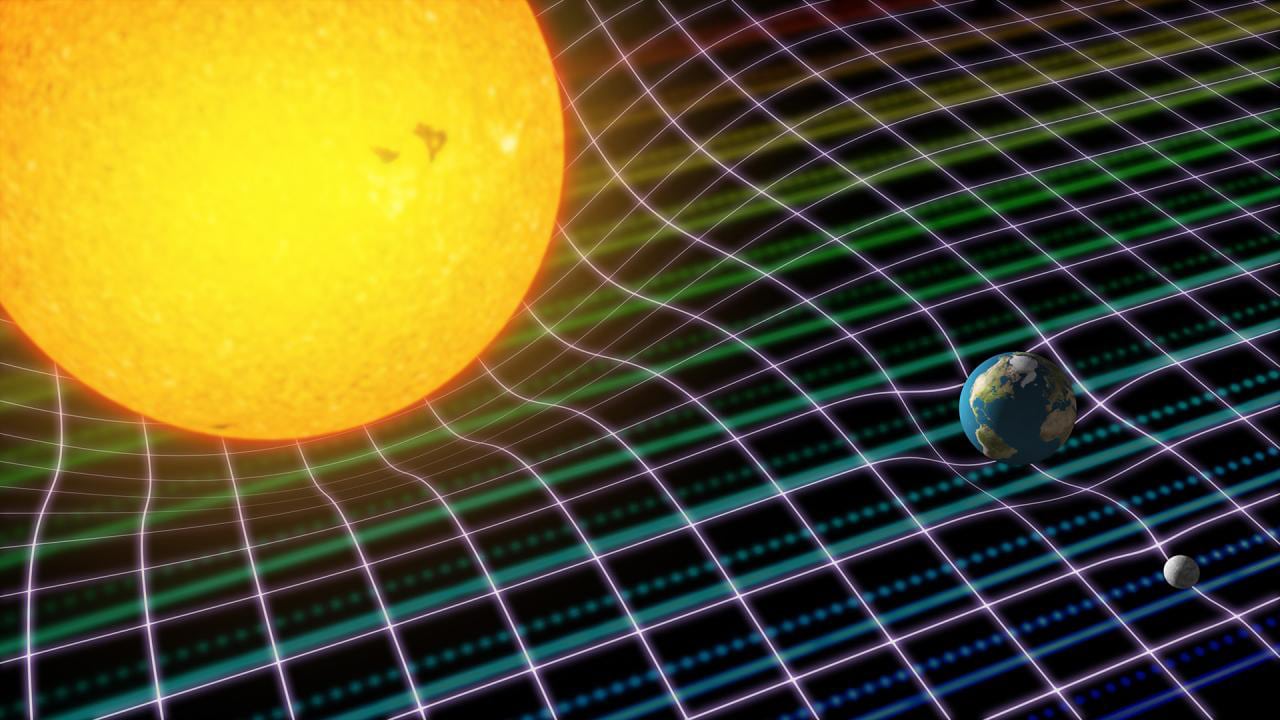
Red-shifts around more massive stars and other bodies are more substantial by virtue of the bodies’ greater masses. This effect was discovered with the development of General Relativity, the theory which posits that matter distorts its local space-time geometry and so can affect the pathways of light.


Leave a Reply