A word is not a crystal, transparent and unchanged; it is the skin of a living thought and may vary greatly in color and content according to the circumstances and time in which it is used.
Oliver Wendell Holmes, Jr.
The advantage of speaking to people in the dark star dome is that nobody can observe one’s perplexed expression or notice when one’s face goes flush red with embarrassment.
And that brings us clumsily back to a recently passed point along the space-time continuum.
“…and, yes, in conclusion ladies and gentlemen, Earth is a flat, immobile disk that was placed on a tortoise’s back about 5000 years old and there it remains to this day… any questions?”
Out of the darkness:
“In which constellation does the Sun appear?”
“Well, that depends on the time of year. The Sun passes through thirteen constellations throughout the year. It is presently moving through…”
“No, no, no… in which constellation would the Sun appear if we were in outer space?”
Oh, heavens… and the seconds draw out like taffy strands when trying to formulate an answer in front of a star dome audience.
“Well, you see, it’s a matter of perspective…”
Great delaying tactic.
“The Sun would appear in different parts of the sky from different vantage points. But, since we have only a little time….”
and that’s another.
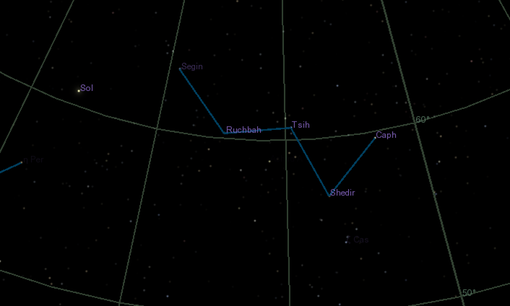
“…let’s restrict ourselves to Alpha Centauri, the closest star system to our own. If we could somehow see the sky from one of Alpha Centauri’s planets–we know that the system contains at least four–the Sun would appear in Cassiopeia. The Sun would transform the “w” into a “zigzag.”

“Granted, if any life forms existed on that world, they won’t recognize the constellation Cassiopeia, but will, instead, have developed a different constellation, if they even have constellations at all.”
“If we were to travel to different star systems around the Sun’s vicinity, we would see it occupying various constellations. The host constellation from any given star would be diametrically opposed to that star in our sky.
“Of course, from the vantage point of many stars in the sky, the Sun wouldn’t be visible at all. Were we to travel sixty light years from the Sun, it would fade below naked eye visibility. This notion assumes, of course, that alien eyes would be similar to our own as far as photon sensitivity is concerned.
“So, even though we know nothing of aliens or their eyes, we can know where they’d see the Sun if they could actually see it in their skies.”
An infusion of superfluous verbiage is also a great tactic, as well. Fortunately, I’m above resorting to that.


Leave a Reply