by Edward Herrick-Gleason
Today, we’ve pulled a question out of Pandora’s Jar: that repository of astronomical queries we keep tucked away in one of the star dome’s many nooks and crannies. This one is particularly interesting as it discusses how far one can travel through the cosmos during one’s lifetime:
“Hey, let’s say I live to be 100. Will I travel more than a light year through space?” -D. Hartford, Casco, Maine
Well, let’s tabulate all the celestial motions we experience. As you mentioned going through space, we will ignore Earth’s rotational motion. First, then, is Earth’s revolutionary motion around the Sun. Although this speed varies slightly throughout the year as a consequence of Earth’s changing distance from the Sun, our planet’s average orbital velocity approximately equals 66,000 miles per hour. That amounts to 578.6 million miles per year.
Let’s assume you will live to be 100 (one, because we like you, and, two, because that number makes the math sweeter.) You will end up traveling 57.9 billion miles around the Sun during your lifetime. Although that distance is considerable, it amounts to about 1% of a light year, or 3.5 light days.
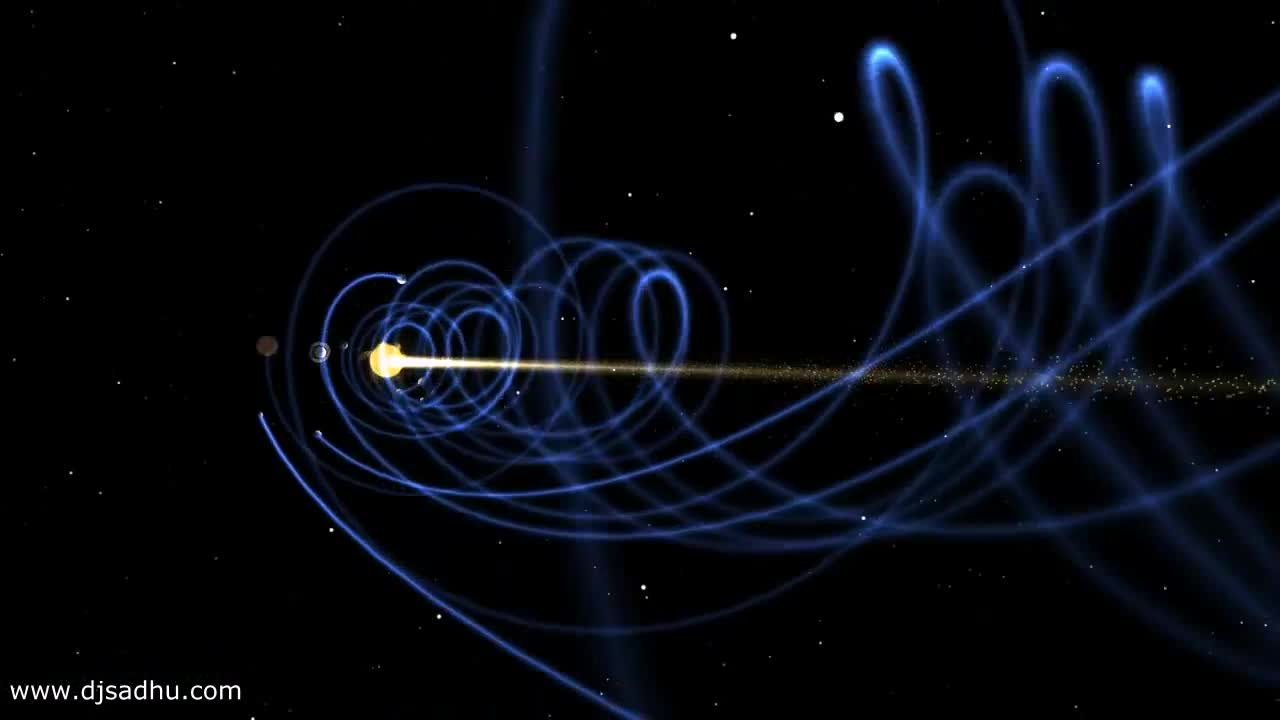
We next proceed to the solar system, which is whipping around the galaxy at a considerably faster clip: 143 miles per second, or 514,800 miles per hour! Over one year, that amounts to 4.5 billion miles! Again, assuming to live to be a centenarian, you will have traveled 450 billion miles through space. However, this unfathomable distance equals 7.5% of a light year. Or, in other words, the distance the solar system traverses in a center at the speed of 143 miler per second equals about 27 light days.
However, that is not the end of the motions! Our Milky Way Galaxy, the second largest member of the local group of more than 54 galaxies, is currently moving toward the Virgo region at 1.3 million miles per hour! This time, we’ll take a wormhole through the intervening mathematical steps and tell you that the galaxy (and you) move 1.13 trillion miles in one century: about 20% of a light year, or 70 light days.
I should qualify this answer by admitting that it is based on simplified assumptions. The Sun’s motion through the galaxy is hardly linear, it weaves up and down along the galactic plane and its speed, like that of Earth, isn’t constant.

Consider this article to be a back of the envelope response to your question. It is safe to say that despite all the rapid celestial motions we experience, we won’t even move a light year through space in our lifetimes.



Leave a Reply