by Susan Herrick-Gleason
Technology is a useful servant but a dangerous master.
Christian Lous Lange

One of the things I am most thankful to my parents for was that they allowed me to grow up mostly car-free. Although my father bought a minivan the year I turned eight and used it to run his own errands and to take us on long family trips, my mother never got a driver’s license, and in my everyday life I rarely asked Dad for rides, having other ways of getting around that didn’t require waiting around for him.
I spent most of my childhood in a small city of a quarter million (plus one year in a large foreign city and my two final years of high school in a college town), and my parents provided me with a monthly bus pass and money to use a taxi service when there wasn’t a bus. But most of the time my mother, my sisters, and I walked. All that walking not only kept me physically fit, it gave me an unusually well-developed sense of direction for someone of my generation. A slower pace and more flexible choice of routes allow a pedestrian to notice so much more of her surroundings than a driver is able to take in, and by spending my childhood getting around on foot, I developed detailed, three-dimensional mental maps of the landscapes where I lived. I didn’t just travel through those landscapes; I was a part of them and they were a part of me. I also loved to study paper maps and compare them to the mental maps I carried around in my brain. I was an excellent navigator on family car trips.
Unlike most of my peers, who equated driving with freedom, I avoided getting my own car until I was twenty-three, knowing that as soon as I had one I would become dependent on it forever. In other words, I would become less free–and less aware of my world. And that’s exactly what happened. I still walked for recreation as much as I could, and I still loved to read maps. But I always took the car when walking or using public transportation would have been inconvenient, especially once I had kids. And because of that, I developed gaps in my understanding of the landscapes through which I travelled.

Then along came GPS. I never planned to own a GPS unit. Maps had always worked so well for me. With a paper map, I’d even navigated successfully the maze of streets in New York City with my husband at the wheel as we drove to his mother’s apartment building in Brooklyn. But, well, once a GPS app appeared on my smartphone, it was just so darned convenient to use it! Instead of taking five to fifteen extra minutes to check a route on the map before heading out the door to new place, I could just hop in the car and go without having any idea where I was going. Yes, the GPS led me astray now and then, but it offered that oh-so-tempting instant gratification. And, anyway, the good, old-fashioned maps were becoming harder and harder to find.
I moved to a new town right around the time I started using GPS, and my town was not particularly pedestrian-friendly, so for years I had a very spare mental map of the area in which I lived. But gradually I started making the effort to look at paper maps again and to go on foot everywhere that was a twenty-minute walk or less from our house. I also continued to hike and walk in natural areas frequently, which enabled me to hone my sense of topography and direction. I had always been fascinated by how I often “knew” where I was in a natural area without a map and compass (and how other people sometimes didn’t), without knowing how I knew, and this fascination increased as I began to read about natural navigation. I wanted to know more–to get to know my familiar wilderness areas more intimately and to learn ways of traveling in unfamiliar regions without getting lost.
A sense of direction is a complicated thing. It is not exactly a “sense” like sight or hearing, but it is not so different, either. Vision is not so automatic as we sometimes imagine. A newborn baby can see but is unable to make meaning out of what he sees because he has not learned to associate the colours and shapes that he sees with objects (green leaves, tree branches) and distances (tree is 25 feet tall but when about 100 feet away appears two inches tall) and words (“tree,” “branch,” “sway,” “wind”) and causes and effects (the swaying back and forth of a tree’s branches is caused by the wind and that he can also feel the wind as a coolness and pressure on his skin and body). Similarly, a “sense” of direction is something that can only be developed through experience in the world, through immersion in landscapes and associations with particular meanings. Just as we can learn to see more at any stage in our lives, we can learn to understand our position on the Earth in a much more detailed and meaningful way.

The twenty-first century human’s reliance on GPS navigation is not without consequence. In accordance with my personal experience, studies show that when people use GPS to navigate, the hippocampus–the part of the brain associated with finding our way in three-dimensional space–is inactive and that the hippocampus is actually becoming atrophied in many people due to the GPS habit. We are becoming more and more reliant on GPS not only because we are forgetting all the other ways that we can navigate but also because we are losing the parts of our brains that allow us to use those other ways. It turns out that following a set of directions does not require us to have a sense of where we are in space. Unfortunately, since the hippocampus is also a part of the brain that is associated with memory, an atrophied or underdeveloped hippocampus is also associated with Alzheimer’s disease. As we become disconnected from the landscapes in which we live, we become disconnected from ourselves and from our memories.
I have started using road maps again, thinking twice before opening that GPS app. And I am delving more deeply into the study of natural navigation techniques, both for practical purposes (I hike a lot and hope to never get seriously lost) and because I love the way it helps me to understand myself as a particular human being in a particular place at a particular time and to share in the cultural memory of the human race.
If you are a beginner in natural wayfinding, one of the easiest places to start is with basic celestial navigation. It is amazingly simply to learn to get a rough estimate of the cardinal directions by looking at the stars, as human beings have been doing for many millennia. (Even if you never have to use that knowledge in an emergency situation, it will help you to orient yourself wherever you are.) And the easiest star pattern to use is the Big Dipper (part of the constellation Ursa Major, the Great Bear).
The Big Dipper is the first (often the only) star pattern that many people learn to recognize and is easy to find because it is always in the sky in the Northern Hemisphere (yes, it’s even there in the daytime, but you won’t see it then because the light from the sun is too bright and drowns out the Big Dipper’s fainter light). The constellation Ursa Major, of which the Big Dipper forms a part, is one of the six circumpolar constellations visible at my latitude (43 degrees North)–“circumpolar” meaning that they appear to revolve around the North celestial pole. (Most other stars and constellations appear to rise, like the Sun, in the east and set in the west. At the North Pole, however, all the visible constellations are circumpolar.)
So, knowing that my house faces North (I originally used a compass to find that out), if I stand with my back to the front of my house and look up into the sky on a clear night, I will be able to find the Big Dipper. It will sometimes be upright and sometimes upside down or standing on its handle or the end of its bowl as it travels in circles around the celestial pole. But regardless of its orientation it will be there, and the two outer stars in the dipper will always point to the North Star, Polaris. Polaris is not exactly at the North Celestial Pole, but it is close enough that it can be used to indicate North with a high degree of accuracy for the purposes of wayfinding (closer to true North than you will get by following a compass needle, which points to the Earth’s magnetic North Pole). Now that you have learned to recognize the Big Dipper, you can find Polaris on any clear night and you will always know which way is North.
The North Star’s height above the horizon, by the way, will always be equal to your latitude; so at my latitude, 43 degrees North, Polaris will be 43 degrees above the northern horizon.

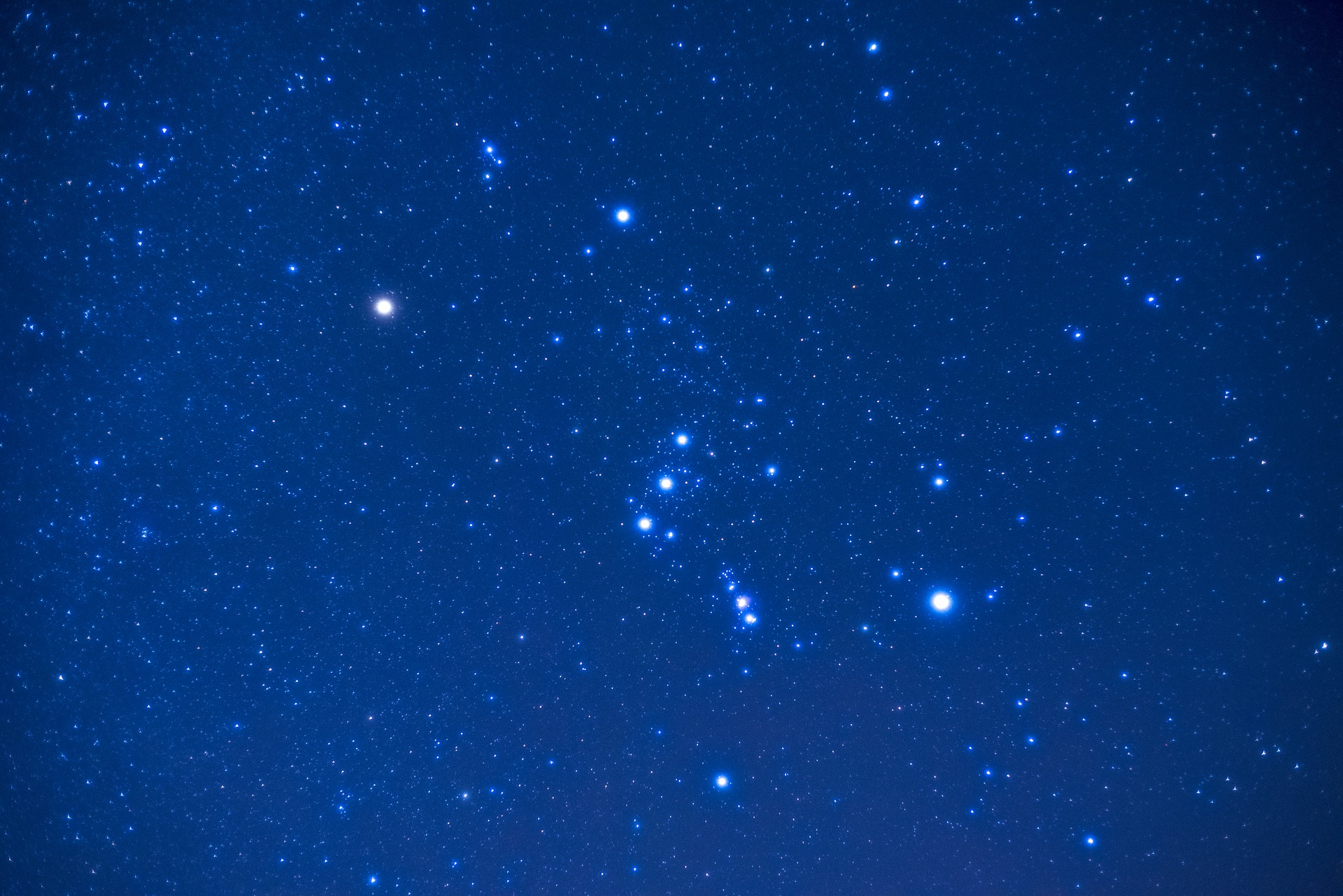
The second star pattern that is familiar to many people is the constellation Orion the Hunter, which appears to travel from East to West across the southern sky. It is easy to recognize due to the three stars that form the more-or-less straight line of the “belt.” Inconveniently, Orion is not visible throughout the year or at all times of night like the Big Dipper. It disappears behind the sun in late May or early June in the Northern Hemisphere and reappears in late July or early August, and it rises and sets at different times during different times of the year, but it is nevertheless an excellent guide to nocturnal travelers except during part of the summer.
Orion is not a circumpolar constellation, so it rises in the east and sets in the west. If it is just above the horizon when you see it, you are looking either east or west. If you wait a little while and it is higher in the sky than it was, it is rising and is therefore in the east; then, if it is on your left hand, you are facing south. If it has gotten lower, it is setting and is therefore in the west; so if it is on your right hand, you are facing south. When it is at its highest point in the sky, and the “sword” that hangs down from the “belt” is pointing straight down at the horizon, it is due south. You can think of Orion’s sword as a sort of compass needle that points to the southern point on the horizon when it is vertical, to a point somewhat east of south when it is rising, and to a point somewhat west of south when it is setting.

But what if you’re traveling during the day? Well, there’s still one star you can use to find your way: our closest star, the Sun. This is the easiest one of all, because you already know what the Sun looks like and you already know that it rises in the east and sets in the west. Well, technically it only rises due east and sets due west on the spring and fall equinoxes (approximately March 20 and September 22). On the summer solstice, in the Northern Hemisphere, it rises significantly north of east and sets significantly north of west (because the Northern Hemisphere is tilted toward the sun during the summer), and on the winter solstice it rises south of east and sets south of west (because the Northern Hemisphere is tilted away from the sun during the winter).
But it will always be due south when it is at its highest point in the sky, so at any time of year if you are looking towards the sun around midday you are facing south. If you are watching the sun rise in early spring or early fall, you are looking east (somewhat north of east in early summer and somewhat south of east in early winter). And if you are watching the sun set, you are looking west (or somewhat north of west or south of west, depending on the time of year).
Here’s another trick for using the sun as a compass, and it works regardless of the time of day. Pick a sunny spot, find a straight stick about three feet long and push it into the ground, and use a rock or other object to mark where its shadow ends. Wait about 15 minutes and mark where the shadow ends now. Since the sun is moving from east to west, its shadow will have moved from west to east. Therefore, if you stand with your left foot on the first rock and your right foot on the second rock, you will be facing North.

There are many, many more ways to find your way without a GPS or a map and compass. Some are as simple as those described here and some require weeks or years of practice. But they will all help you to develop a closer connection to the landscapes (and skyscapes) and surround you, and I encourage you to learn more of them and maybe even discover some of your own. Learning them will make you smarter and more self-reliant and might even save your life some day. Most importantly, they will give you a greater sense of belonging in a world where so many of us feel disconnected and out of place.

Leave a Reply