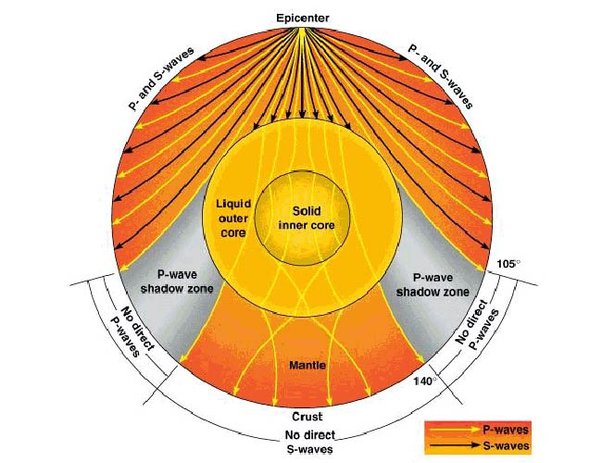
How do scientists study Earth’s interior? It is all done with the seismic waves generated by Earthquakes. We can separate these waves into two types:
- P waves, or primary/pressure waves
- S waves, or secondary waves
P waves are longitudinal compression waves whose movement is similar to the motion of a Slinky:

S waves exhibit a motion perpendicular to the direction of the motion, like that of a rope:

Whereas P waves travel along the direction of motion, S waves oscillate up and down along the motion path:

Here’s the rub: P waves can travel through solids, liquids and even gases, but S waves can only move through solids. Moreover, seismic waves travel at different velocities through different types of materials. (Sound waves also travel at different speeds through different media. For instance, sound travels at about 767 miles per hour through air at room temperature, but can travel at 10,200 miles per hour through copper. Sound travels very quickly through metals; consequently, one can hear a train approaching from quite a long distance merely by pressing an ear to a railroad track.)
When an Earthquake or another powerful wave-generating event such as a volcanic eruption occurs, seismic waves propagate through Earth in all directions and can be detected by seismographs at other locations. By studying the seismographs throughout these locations, scientists can determine which waves are transmitted and the speed at which these waves travel. Since S waves cannot travel through liquid, they won’t be detected along any point within the ‘S-wave shadow zone, which extends along a 154-degree arc opposite the location of the seismic wave source (i.e., Earthquake) However, P waves are detected at all locations except for two more narrow “P shadow zone” regions. The refraction within the liquid outer core leaves gaps that produce these two shadow zones.


Since Earthquakes are quite common, scientists have been able to quite accurately map the planet’s interior (the crust, mantle, liquid outer core, and solid inner core) by analyzing both of these wave types generated by sources at multiple locations.


Leave a Reply